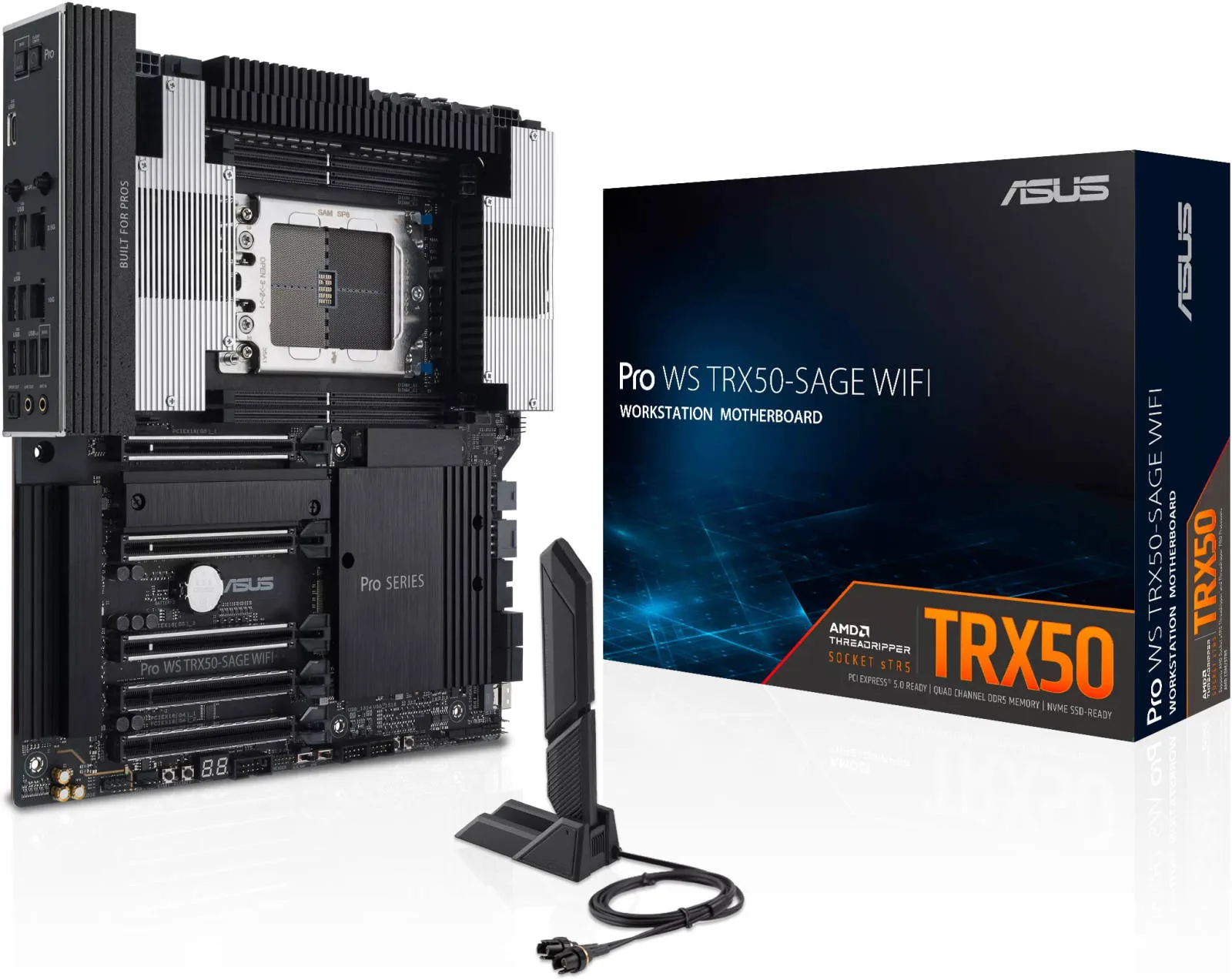
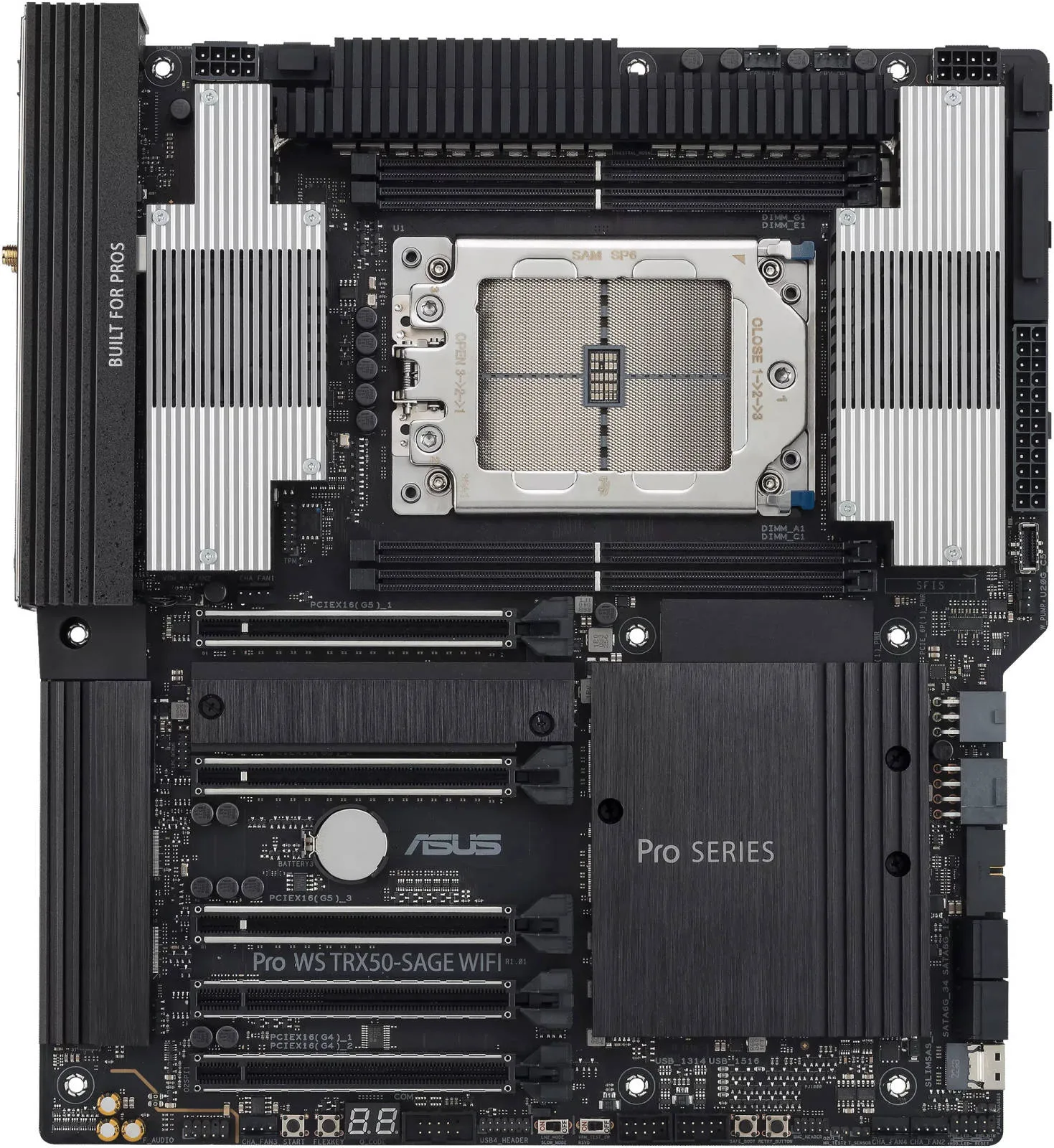
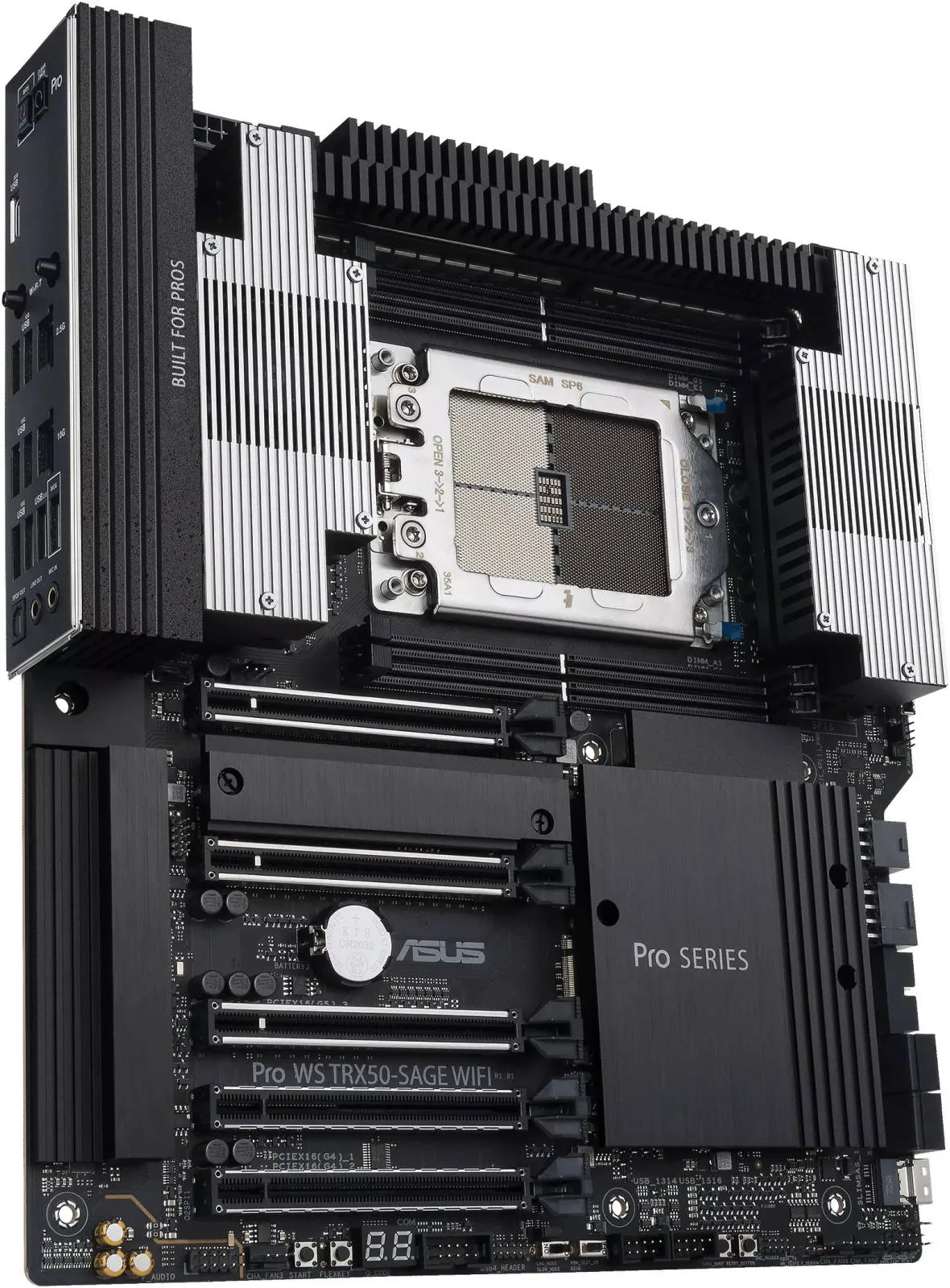
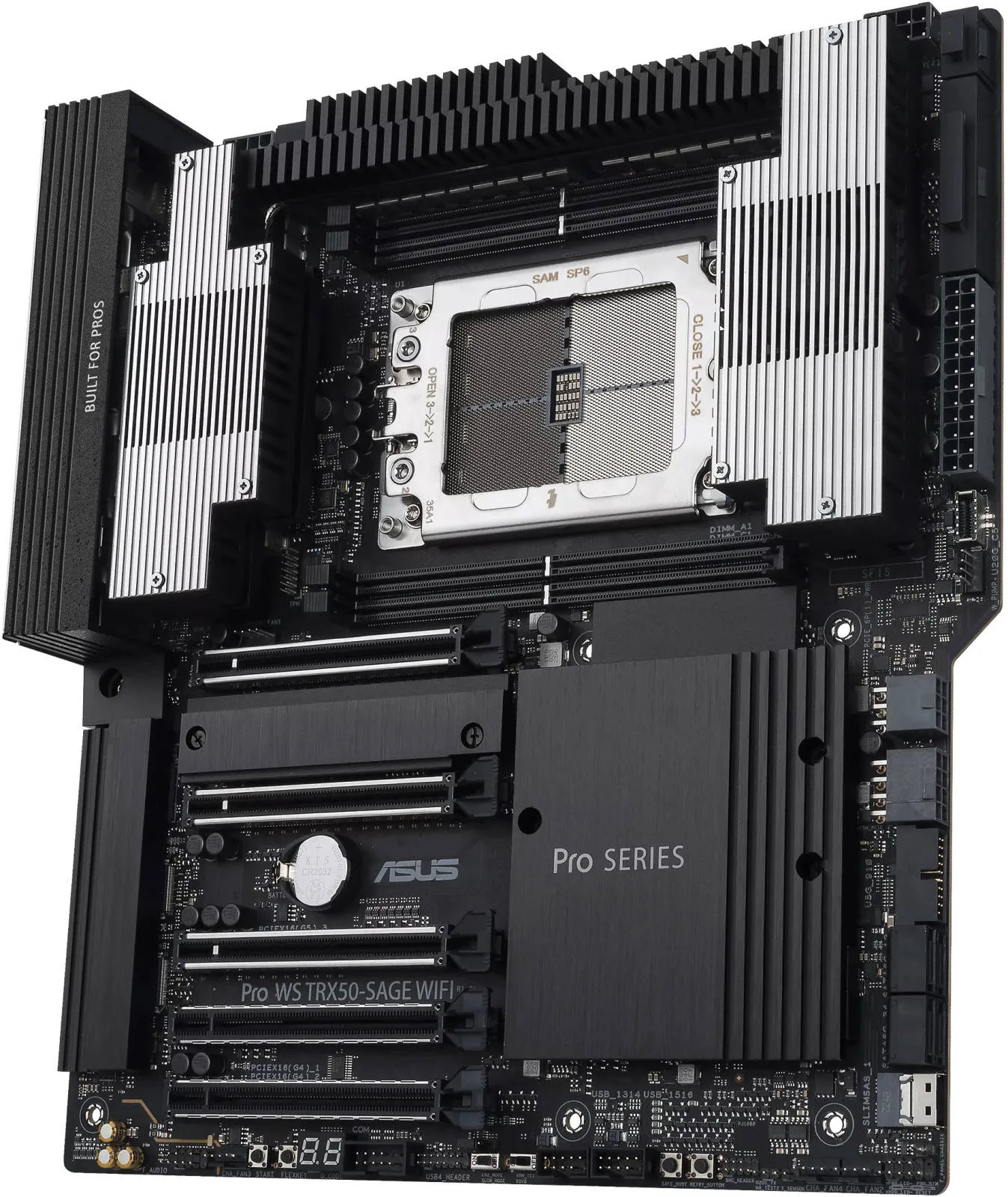
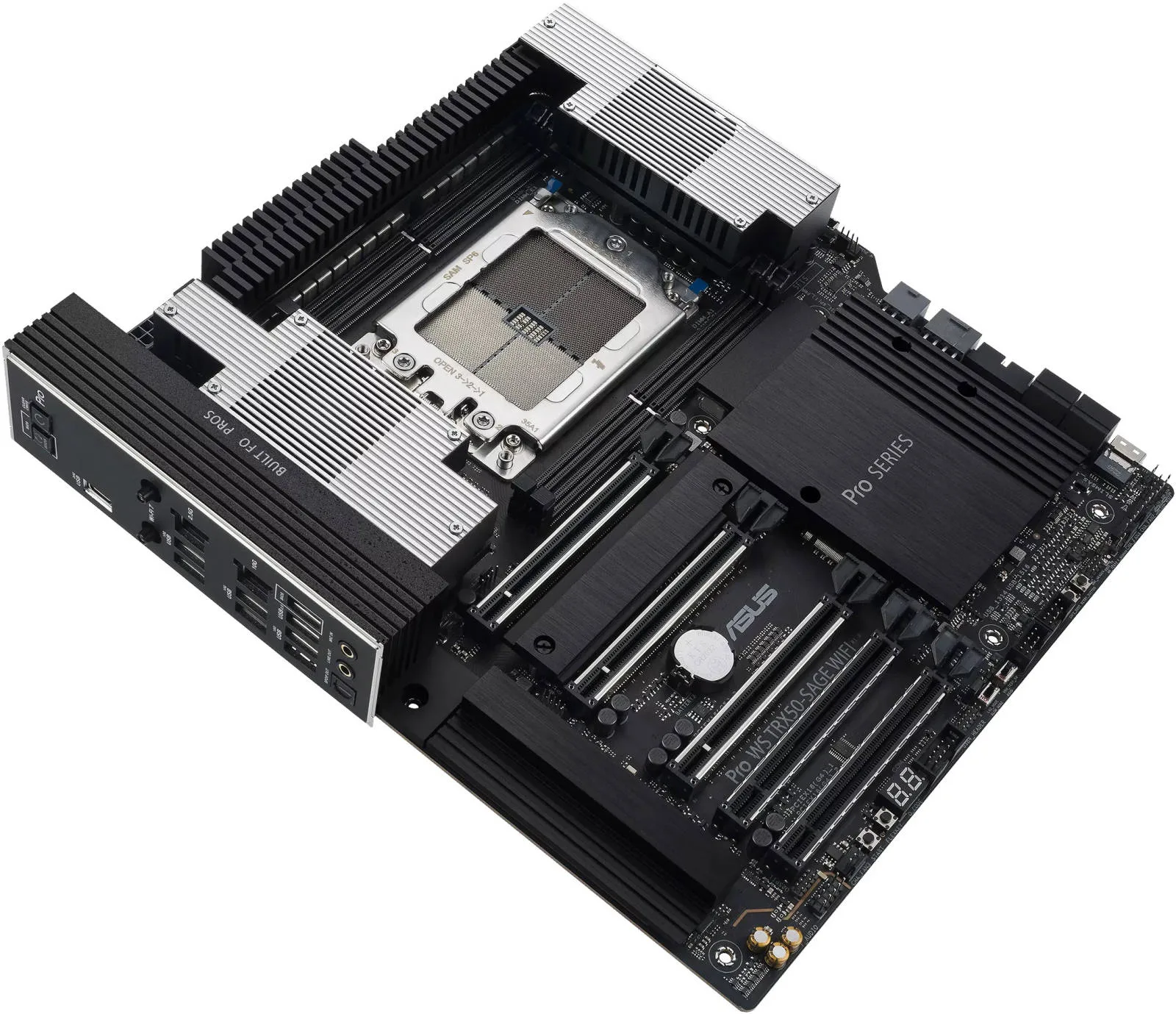
Asus Pro WS TRX50-SAGE WIFI AMD sTR5 CEB Workstation Motherboard, AMD TRX50 Chipset, 4x DIMM DDR5 / 1TB Max Memory, 3x M.2 Slot, 5x PCIe x16 Slot
- Pro WS TRX50-SAGE WIFI
- AMD sTR5 CEB workstation motherboard, CPU and memory overclocking ready, robust 36 power-stage design, PCIe 5.0 x 16, PCIe 5.0 M.2, 10 Gb and 2.5 Gb LAN, multi-GPU support
- Features
- AMD sTR5 socket supports up to 96-core CPUs: Ready for AMD Ryzen™ Threadripper™ PRO 7000 WX-Series Processors and AMD Ryzen Threadripper 7000 Series Processors.
- CPU and memory overclocking: Support for up to 1TB ECC R-DIMM DDR5 memory modules (1DPC)
Warranty: 1 Year — effortless warranty claims with UK-wide coverage. Learn more
Key specifications
- Socket
- sTR5
- Chipset
- AMD TRX50
- Form factor
- CEB
- Memory type
- DDR5
- Memory slots
- 4
Details
- Shipping Weight
- 3.60 Kg
- Shipping Dimensions
- 10.00 cm x 38.00 cm x 33.00 cm
- M.2 Slots
- 3
- Maximum Memory
- 1 TB
- Multi-GPU Support
- 2-Way SLI 2-Way CrossFire
- PCI Express x16
- 5
- CPU
- AMD Socket sTR5 for Ryzen™ Threadripper™ PRO 7000 WX-Series and Ryzen™ Threadripper™ 7000 Series Processors
- Memory
- 4 x DIMM slots, DDR5, ECC Registered Memory4 Channel Memory Architecture
- Expansion Slots
- AMD Ryzen™ Threadripper™ PRO 7000 WX-Series and Ryzen™ Threadripper™ 7000 Series Processors2 x PCIe 5.0 x16 slots1 x PCIe 5.0 x16 slot(x8 mode)1 x PCIe 4.0 x16 slot1 x PCIe 4.0 x16 slot(x4 mode)
- Storage
- Total supports 3 x M.2 slots, 4 x SATA 6Gb/s ports AMD Ryzen™ Threadripper™ PRO 7000 WX-Series and Ryzen™ Threadripper™ 7000 Series ProcessorsM.2_1 slot (Key M), type 2242/2260/2280 (supports PCIe 5.0 x4 mode)M.2_2 slot (Key M), type 2242/2260/2280 (supports PCIe 5.0 x4 mode)AMD TRX50 ChipsetM.2_3 slot (Key M), type 2280(supports PCIe 4.0 x4 mode)4 x SATA 6Gb/s ports1 x SlimSAS slot supports PCIe 4.0 x4 mode NVMe device
- Ethernet
- 1 x Marvell® AQtion 10Gb Ethernet1 x Intel® I226-LM 2.5Gb Ethernet
- Wireless & Bluetooth
- Wi-Fi 7*2x2 Wi-Fi 7 (802.11be)**Supports 2.4/5/6GHz frequency band***Support Wi-Fi 7 160MHz bandwidth, up to 2.8Gbps transfer rate.Bluetooth® v5.4***** Compatible with Windows 11 or later.** Wi-Fi 7 MLO(Multi-link Operation) full functions support will be ready in Windows 11 2024 Platform (Windows 11 24H2) or later.*** Wi-Fi 6GHz frequency band and bandwidth regulatory may vary between countries.**** The Bluetooth version may vary, please refer to the Wi-Fi module manufacturer's website for the latest specifications.
- USB
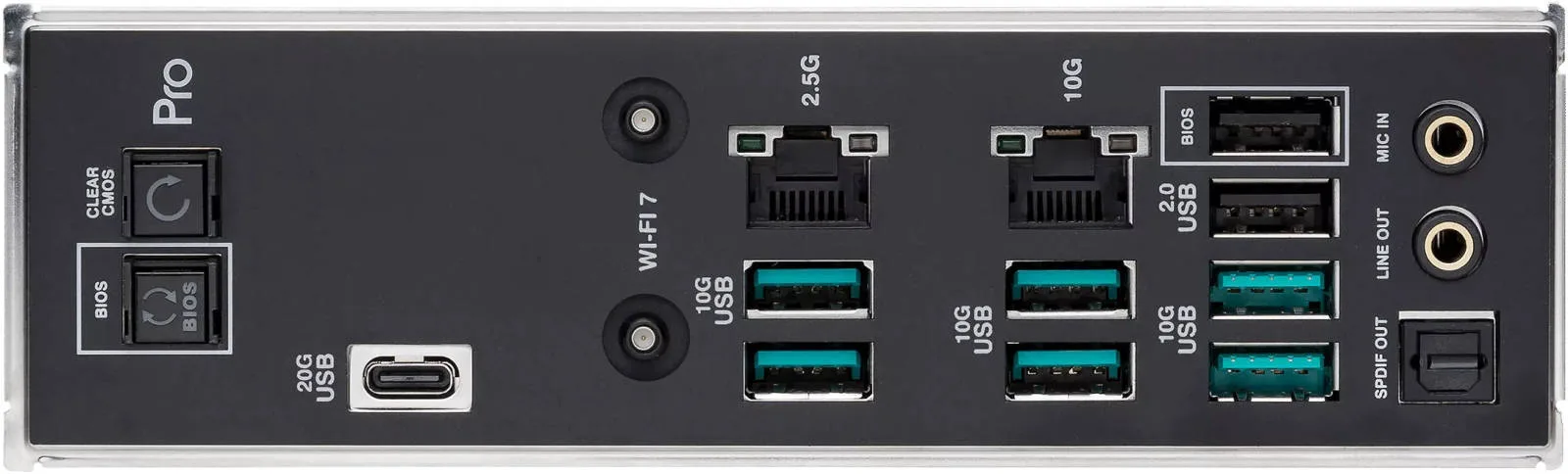
- Rear USB (Total 9 ports)1 x USB 20Gbps port (1 x USB Type-C®)6 x USB 10Gbps ports (6 x Type-A )2 x USB 2.0 ports (2 x Type-A )Front USB (Total 7 ports)1 x USB 20Gbpsconnector (supports USB Type-C® with up to 27W PD/QC4+)1 x USB 5Gbps header supports 2 additional USB 5G ports2 x USB 2.0 headers support additional 4 USB 2.0 ports
- Audio
- Realtek ALC1220P Surround Sound High Definition Audio CODEC*- Impedance sense for front and rear headphone outputs- Internal audio Amplifier to enhance the highest quality sound for headphone and speakers- Supports: Jack-detection, Multi-streaming, Front Panel Jack-retasking- High quality 120 dB SNR stereo playback output and 113 dB SNR recording input (Line-in)- Supports up to 32-Bit/192 kHz playback
- Back Panel I/O Ports
- 1 x USB 20Gbps port (1 x USB Type-C®)6 x USB 10Gbps ports (6 x Type-A)2 x USB 2.0 port (2 x Type-A)1 x Wi-Fi Module1 x Marvell® AQtion 10Gb Ethernet port1 x Intel® 2.5Gb Ethernet port2 x Audio jacks1 x Optical S/PDIF out port1 x BIOS FlashBack™ button1 x Clear CMOS button
- Internal I/O Connectors
- Fan and Cooling related1 x 4-pin CPU Fan header1 x 4-pin CPU OPT Fan header1 x W_PUMP+ header4 x 4-pin Chassis Fan headers2 x 4-pin VRM Fan header (with VRM FAN onboard)Power related2 x 24-pin Main Power connectors2 x 8-pin +12V Power connectors2 x 8-pin PCIe to CPU power connectors1 x 6-pin PCIe Power connector1 x 8-pin PCIe Power connectorStorage related3 x M.2 slots (Key M) 4 x SATA 6Gb/s ports1 x SlimSAS portUSB1 x USB 20Gbps connector supports USB Type-C®1 x USB 5Gbps header supports 2 additional USB 5Gbps ports2 x USB 2.0 headers support additional 4 USB 2.0 portsMiscellaneous1 x BMC header1 x COM Port header1 x USB4 header1 x FlexKey button1 x Front panel audio header (F_AUDIO)1 x Start button1 x Safe boot button1 x ReTry button1 x LN2 mode jumper1 x Slow mode switch1 x SPI TPM header (14-1pin)1 x 10⁻¹ pin system panel header1 x Chassis intrusion header1 x Thermal Sensor header
- Special Features
- ASUS Q-Design- Q-Code- M.2 Q-Latch- Q-Connector- Q-DIMM- Q-LED (CPU [red], DRAM [yellow], VGA [white], Boot Device [yellow green])- Q-SlotASUS Thermal Solution- M.2 heatsink and onboard thermal pads- VRM heatsink design with active fansASUS EZ DIY- BIOS FlashBack™ button- BIOS FlashBack™ LED- Clear CMOS button- ProCool II- Pre-mounted I/O shield- SafeSlot- SafeDIMMBespokeMotherboard Design & Business Focused Features- 24/7 Reliability- Overcurrent Protection
- Software Features
- ASUS Exclusive SoftwareArmoury Crate- Fan Xpert 4ASUS CPU-ZIT Management software supported- ASUS Control Center Express(ACCE)Adobe Creative Cloud (Free Trial)Norton 360 Deluxe (60 Days Free Trial)WinRAR (40 Days Free Trial)UEFI BIOSASUS EZ DIY- ASUS CrashFree BIOS 3- ASUSTeK. EzFlash UtilityFlexKey
- BIOS
- 256 Mb Flash ROM, UEFI AMI BIOS
- Manageability
- WOL by PME, PXE (UEFI mode)
- Accessories
- Cables2 x SATA 6Gb/s cables1 x CPU 8-pin to PCIe 8-pin adapter cable package1 x Thermistor cable packMiscellaneous1 x ASUS 2x2 Dual-Band Wi-Fi moving antennas1 x M.2 Q-Latch package(2 in 1)2 x M.2 Rubber Packages1 x Q-connectorDocumentation1 x ACC Express Activation Key Card1 x QSG
4.88 reviews
Got something to share?
Rate this product — your experience helps other buyers.
Oscar L. Used for: 3–6 months
Pros
Rock solid once configured, and the lane allocation is completely transparent
Cons
The BIOS is a workstation BIOS and it assumes you know the platform
Comment
Very capable board that asks something of you in exchange, which is worth knowing before you order one. The firmware is not friendly. There are settings here that a desktop board would never expose, the defaults are conservative rather than optimal, and the memory section in particular will let you do things that stop the machine posting. Setting it up properly took me an evening with the manual and a forum tab open, where a consumer board would have been ten minutes. Once configured it has been immovable for five months. Four channels of ECC at the rated speed, no correctable errors logged, VRM in the low fifties under a full load with 64 threads busy, and both network ports saturating without any tuning. So four stars rather than five, purely because the first evening is harder than it needs to be. If you have run workstation hardware before it will feel familiar. If not, budget the time.
Grace E. Used for: Less than a month
Pros
Threadripper with ECC and Wi-Fi on one board
Cons
CEB, so measure first
Comment
Went in fine, runs everything, no notes!
Ella B. Used for: 6–12 months
Pros
Onboard management is a proper feature here, not an upsell
Comment
Remote console and power control on a workstation board that also has Wi-Fi and a normal audio codec. It means the render box lives in the cupboard and I never go near it, though running a cable to the cupboard was a job in itself
George N. Used for: 3–6 months
Pros
Four channel memory bandwidth is the whole point and it delivers
Cons
Fan headers are sparse for a board this size
Comment
Simulation work that was memory bound on a desktop platform now scales properly, which is exactly why you pay for Threadripper. Board has been completely stable at the rated memory speed. Only six fan headers though, and in a case with nine fans that meant splitters and a hub, which felt mean on a board of this class.
Isla L. Used for: Less than a month
Pros
Every PCIe slot is full width and full speed, no exceptions
Comment
Bought specifically because I was tired of reading lane sharing tables. Two graphics cards, a capture card and a 10G adapter, every one of them at the full sixteen or eight lanes it wants, and the manual states it plainly instead of hiding it in a footnote. Went together in an afternoon and posted first time with all four DIMMs populated.
Ivy K. Used for: More than a year
Pros
Long service with no correctable errors logged at all
Cons
No onboard video, so a card is compulsory
Comment
Long service with no memory errors logged at all. Worth knowing there is no display output on the board itself, so even a headless build needs a card in a slot.
Freya F. Used for: Less than a month
Comment
Assembled it into a Define 7 XL and the CEB size was the only thing that needed thought, everything else went in as though the case had been made for it. Four sticks of registered ECC trained on the first boot with no manual timings. All three M.2 slots detected. The Wi-Fi found the network before I had the side panel back on, which on a workstation board is a nice surprise rather than an expectation. Very happy with it so far
Oscar H. Used for: More than a year
Pros
Four channel ECC and every slot at full width, with no lane games at all
Comment
This is the board that finally let me put the whole studio into one machine. A 7970X, four channels of registered ECC, two GPUs at full sixteen lanes each, a 10G card and three NVMe drives, and nothing anywhere is sharing a lane with anything else. On every consumer board I looked at, that configuration meant giving something up. Here it just works, and the block diagram in the manual is honest about it. Thermally it is unremarkable in the way you want. The VRM heatsink is enormous and stays under fifty with the processor pulling 350W, and the M.2 heatsinks keep drives off their throttle limit through long exports. Seventeen months in and the numbers are where they were on day one. The one thing I would say to anyone considering one is that the CEB footprint is not ATX. Check your case, check your standoffs, and check the power supply cables reach, because mine did not.