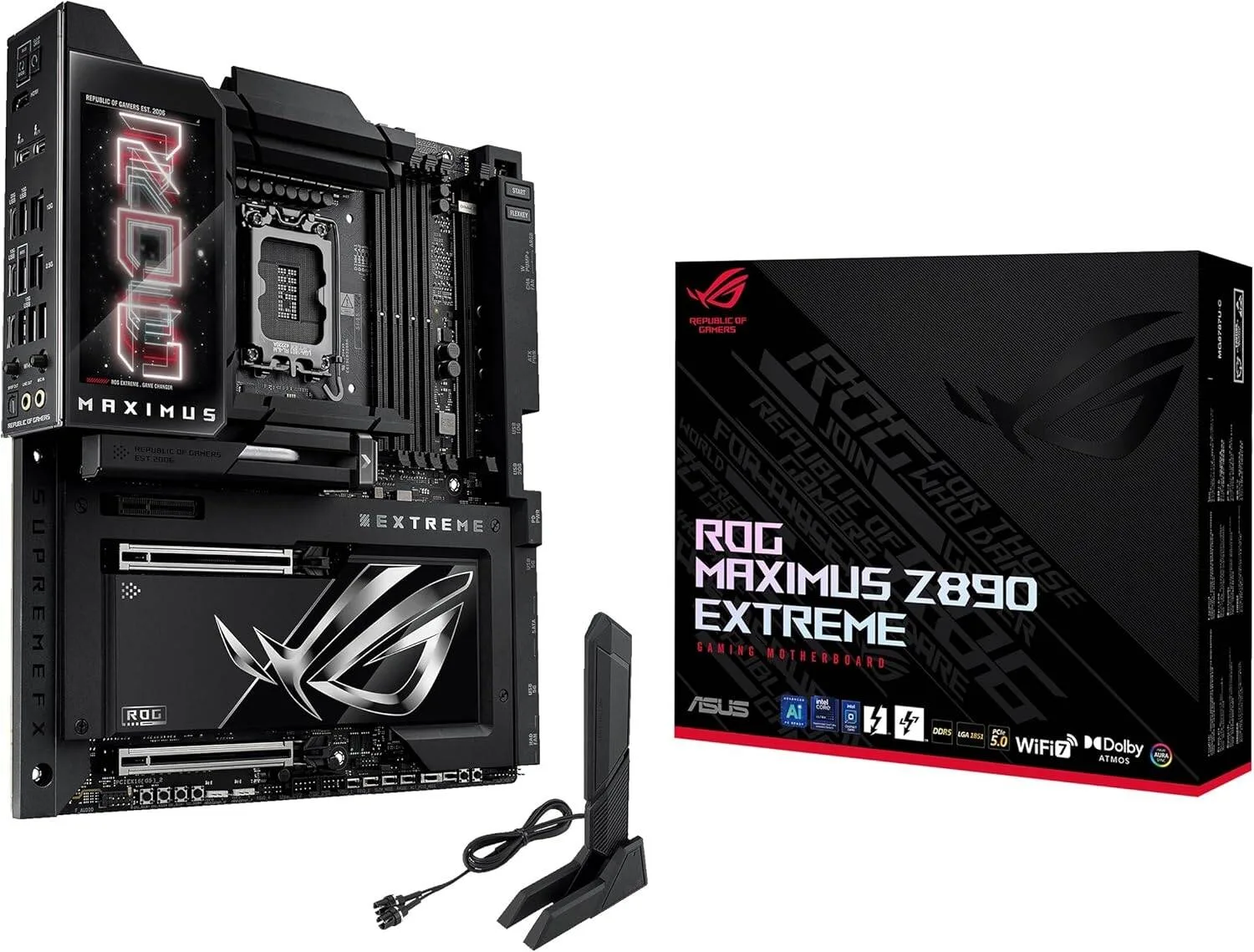
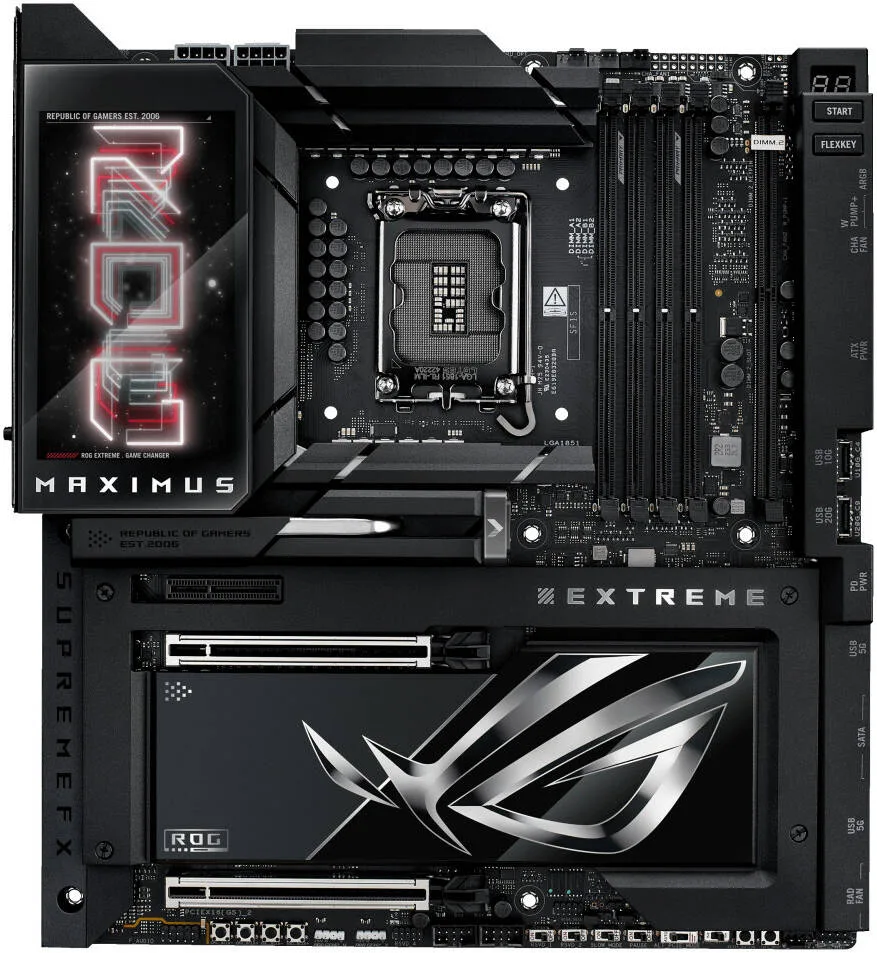
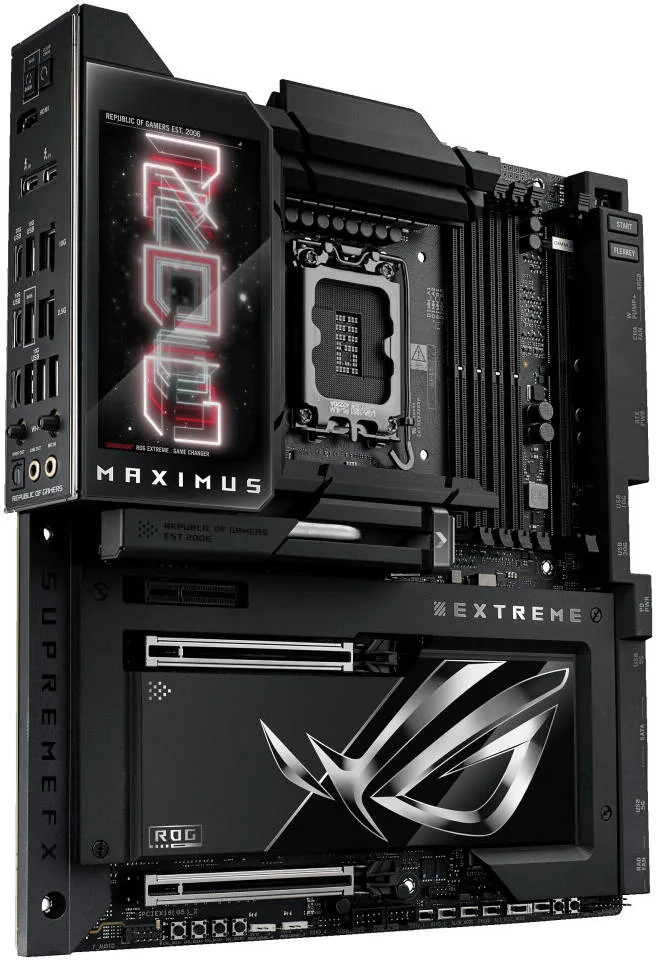
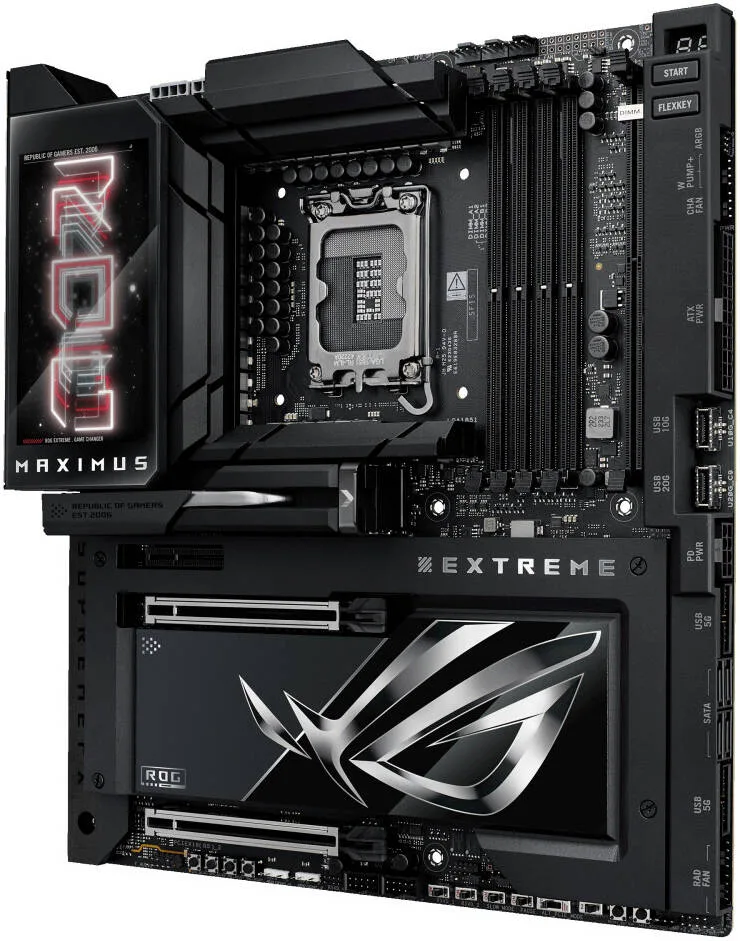
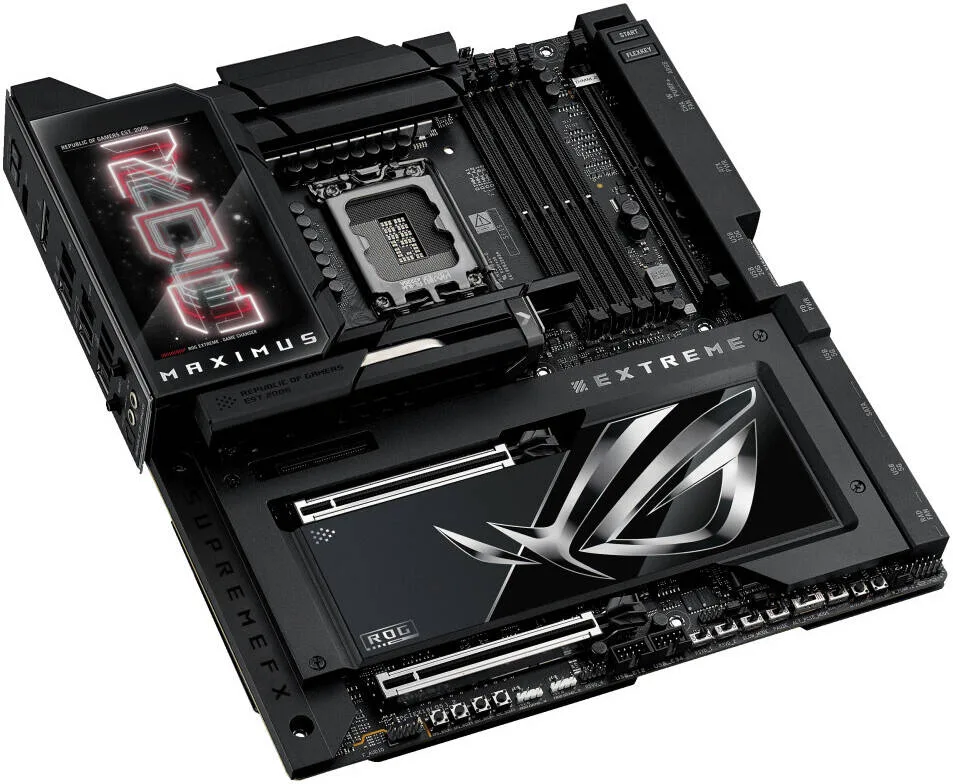
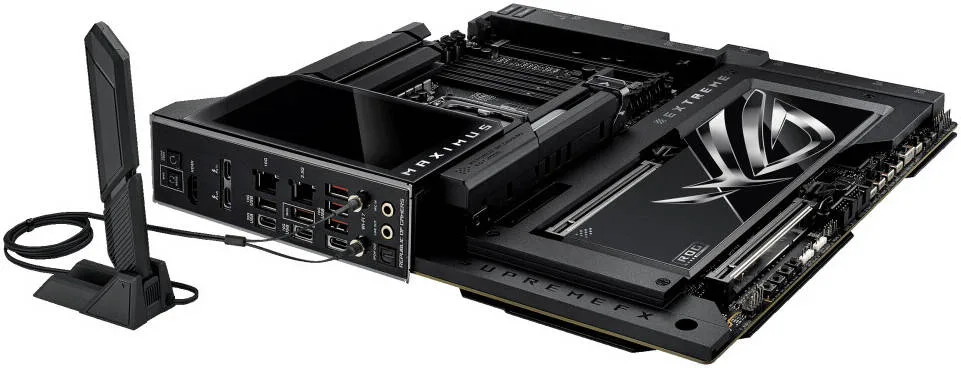
ASUS ROG Maximus Z890 Extreme LGA 1851 ATX Motherboard, Intel Z890 Chipset, 4x DDR5 DIMM Slots, Up to 192GB Max Memory, Wi-Fi 7 & BT 5.4, 2x PCIe 5.0 x16 Slots, 6x M.2 Slots
- Ready for Advanced AI PCs: Designed for the future of AI computing, with the power and connectivity needed for demanding AI applications
- Intel® LGA 1851 Socket: Supports Intel Core™ Ultra Processors (series 2)
- Exclusive AI Technologies: ASUS AI Advisor, AI Overclocking, AI Cooling II and AI Networking II to simplify setup and enhance performance
- Advanced Overclocking & Memory Technology: NPU Boost, NitroPath DRAM Technology, DIMM Fit, DIMM Flex and AEMP III
Warranty: 1 Year — effortless warranty claims with UK-wide coverage. Learn more
Key specifications
- Socket
- LGA 1851
- Chipset
- Intel Z890
- Form factor
- E-ATX
- Memory type
- DDR5
- Memory slots
- 4
Details
- Shipping Weight
- 5.40 Kg
- Shipping Dimensions
- 12.50 cm x 38.00 cm x 32.00 cm
- M.2 Slots
- 6
- Maximum Memory
- 192 GB
- PCI Express x16
- 2
- CPU
- - Supports Intel® Core™ Ultra Processors (Series 2), LGA1851 - Supports Intel® Turbo Boost Technology 2.0 and 3.0 (CPU type dependent) - CPU support list
- Memory
- - 4 x DIMM slots, max. 192GB, DDR5 - Supports up to 9200+MT/s (OC), Non-ECC, Unbuffered - Dual Channel Architecture - Supports XMP, AEMP III, DIMM Flex, NitroPath DRAM Technology - Memory support
- Graphics
- - 1 x HDMI port (max. 8K@60Hz) - 2 x Thunderbolt™ 5 ports (supports multiple monitors, up to 8K@60Hz) - Graphics specs may vary by CPU type
- Expansion Slots
- - 2 x PCIe 5.0 x16 slots, 1 x PCIe 4.0 x4 slot - PCIe bifurcation table
- Storage
- - Up to 6 x M.2 slots, 4 x SATA 6Gb/s ports - RAID support for various configurations
- Ethernet
- - 1 x Intel® 2.5Gb Ethernet - 1 x Marvell® AQtion 10Gb Ethernet - ASUS LANGuard
- Wireless & Bluetooth
- - Intel® Wi-Fi 7 (802.11be), up to 5.8Gbps - Bluetooth® v5.4
- USB Ports
- Rear: 10 ports (2 x Thunderbolt™ 5, 1 x USB 20Gbps, 7 x USB 10Gbps) Front: 10 ports (1 x USB 20Gbps, 1 x USB 10Gbps, 2 x USB 5Gbps, 2 x USB 2.0 headers)
- Audio
- - ROG SupremeFX 7.1 Surround Sound - High definition audio CODEC ALC4082 - ESS® ES9219 QUAD DAC
- Back Panel I/O Ports
- - 2 x Thunderbolt™ 5 USB Type-C® - 1 x USB 20Gbps port - 7 x USB 10Gbps ports - 1 x HDMI port - 1 x Intel® 2.5Gb Ethernet port - 1 x Marvell® AQtion 10Gb Ethernet port - 2 x LED-illuminated audio jacks
- Internal I/O Connectors
- - Fan headers, power connectors, storage connectors (4 x M.2 slots, 4 x SATA 6Gb/s ports)
- Miscellaneous
- - 1 x 6-pin ARGB Gen 2 header, various buttons and headers for additional functionalities
- Special Features
- - Extreme OC Kit, Extreme Engine Digi+, ASUS Q-Design, ASUS Thermal Solution, ASUS EZ DIY, Aura Sync, Dual BIOS, Full Color LCD Display, ROG M.2 PowerBoost
- Software Features
- - ROG Exclusive Software (CPU-Z, Dolby Atmos, Internet Security) - ASUS Exclusive Software (Armoury Crate, Fan Xpert 4, etc.)
- BIOS
- 2 x 256 Mb Flash ROM, UEFI AMI BIOS
- Manageability
- WOL by PME
- Accessories
- Includes various cables, connectors, thermal pads, and installation media (USB drive with utilities and drivers)
- Operating System
- Windows 11 (22H2 & later)
4.37 reviews
Got something to share?
Rate this product — your experience helps other buyers.
Ella N. Used for: 6–12 months
Pros
Thunderbolt, 5G LAN and an absurd VRM in one board
Cons
Half the rear USB ports share bandwidth in a way the manual buries
Comment
Superb board with one genuine gripe that took me a while to work out. The good first. Power delivery is beyond anything a 285K can ask for, so the VRM never leaves the low forties even during a long render. Memory training is quick, both USB4 ports drive 4K displays off one cable, and the Q-Latch system means no dropped screws inside the case ever again. The gripe is the rear IO. Several of the type A ports hang off the same controller, and if you have an audio interface and an external SSD plugged in you will find out about it the first time you record. The manual does document this, in a block diagram on a page you would never think to read. Once I moved the interface to a dedicated port it has been perfect. Eight months of recording since and not a single dropout.
Willow N. Used for: More than a year
Pros
Q-Code display and BIOS flashback take the fear out of a build
Cons
The price is properly silly
Comment
Diagnostics alone justify half the cost, the rest is badge. Memory at 8000 without touching a voltage, which surprised me on four slot DDR5.
Theo P. Used for: More than a year
Pros
Carried two different processors without so much as a reset
Comment
Two years of daily use on this board across two processors and it has not put a foot wrong. Started with a 265K and moved to a 285K without so much as a BIOS reset. The VRM is absurdly over specified for anything you can put in socket 1851, which means it never gets warm, never throttles and the fans above it have never spun up under a rendering load. Five M.2 slots, all populated, no lane sharing to worry about. One star off and it is purely money. What you are buying over the Hero is a second network port, the extra storage and the diagnostics, and only you can decide whether that is worth the gap.
Rosie C. Used for: 3–6 months
Pros
Rock steady with a 285K and an 8000 memory kit
Cons
The bundled software suite is bloated
Comment
No stability complaints whatsoever, the memory profile held from the first boot. Armoury Crate is the usual mess and I removed it, static lighting set in the BIOS instead.
Arthur W. Used for: 1–3 months
Pros
Q-Release for the graphics card is the best thing on the board
Comment
The button that releases the graphics card without reaching under it is worth more to me than any of the RGB, because I swap cards for testing and the retention clip on my last board was a knuckle grater. Everything else works as you would expect at this level, memory at 8400 on the first try and Wi-Fi 7 connected before Windows finished installing. Two months on, the release button is still the thing I mention when anyone asks about it. Marked down only for the ridiculous outlay.
Freya K. Used for: Less than a month
Pros
BIOS flashback meant I could update before the CPU went in
Cons
Two of the M.2 slots end up under the graphics card
Comment
Built this into a Torrent at the weekend and the flashback button earned its keep, because the board shipped on an older firmware than my 285K wanted and a USB stick sorted it with no CPU installed. Everything since has been effortless. The only grumble is that the lower M.2 slots sit under a big graphics card, so populate them before you fit it or you will be doing the job twice.
Alfie S. Used for: 6–12 months
Comment
Bought as the last Intel board I will need for a while and it has been a quietly excellent thing to live with. What I did not expect is how much difference the fan control makes. Six headers, all of them able to follow either CPU or water temperature, and the curve editor in the BIOS is the clearest I have used. The machine idles almost silent and only becomes audible under a long export. Networking has been faultless on both the 5G port and Wi-Fi 7, memory sits at 8000 with no manual work, and the Q-Code readout has never shown me anything but the boot sequence. The best part of a year of that and nothing has changed.