Teltonika RUT951 Industrial 4G LTE Router, Up to 150 Mbps Speed, Dual SIM, 4x Ethernet with VLAN, WAN Failover, RMS Compatible, LTE, PoE without PSU
Teltonika
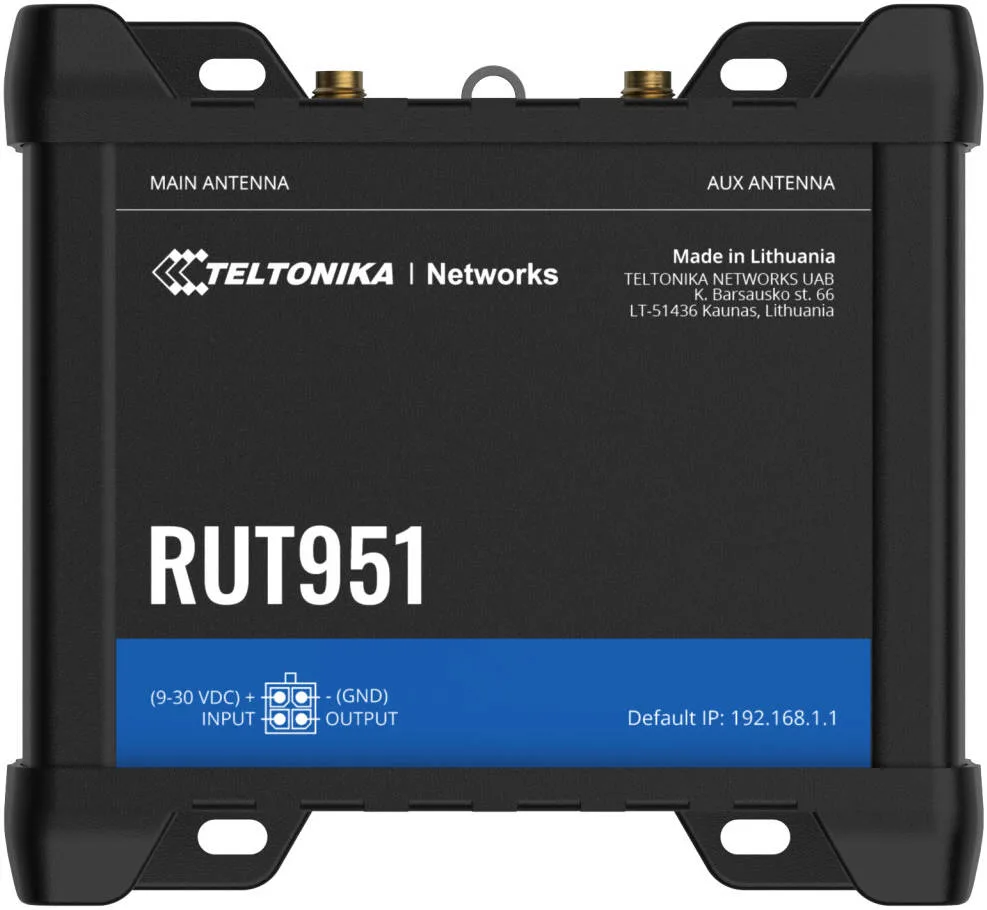
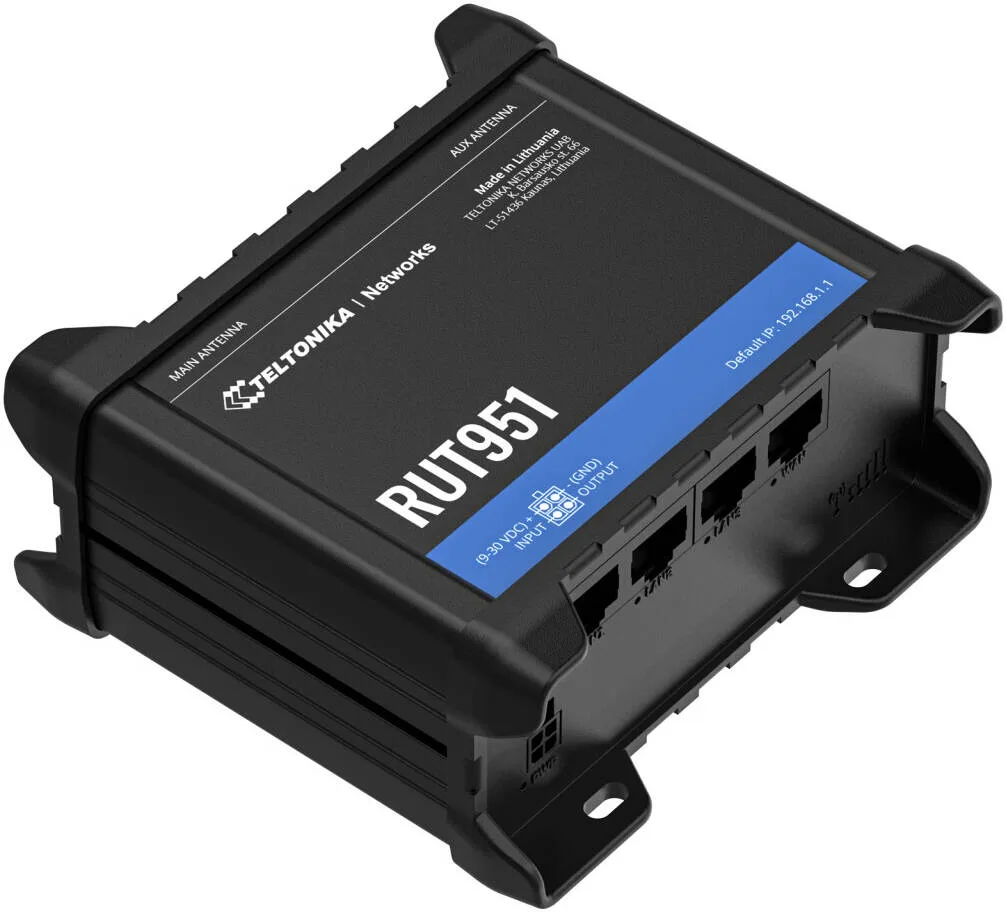
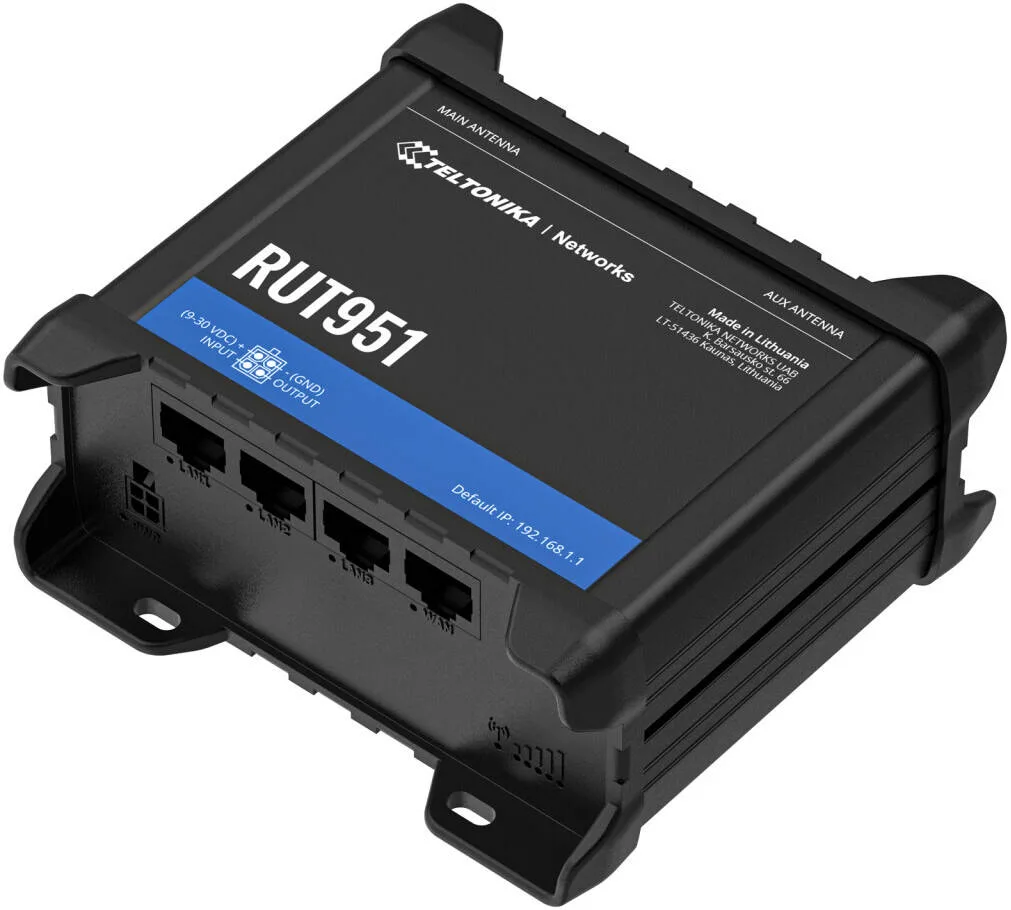
- The TeltonikaRUT951 leverages the best features of one of Teltonika Networks'most popular industrial routers , the RUT950.The TeltonikaRUT951 is a professional industrial 4G LTE router with Wi-Fi connectivity for IoT applications. It operates over Wi-Fi in the 2.4 GHz band and IEEE 802.11b/g/n standard. It has 4 Ethernet ports. The LTE modem offers up to 100 Mbps downlink and up to 50 Mbps uplink throughput. The device is rugged, protected by an aluminum housing. The LTE router features high performance mobile communications over a wide temperature range and harsh operating conditions.
- 4G/LTE (Cat 4), 3G, 2G
- Automatic switch to available backup connection
Warranty: 1 Year — effortless warranty claims with UK-wide coverage. Learn more
Details
- Shipping Weight
- 0.60 Kg
- Shipping Dimensions
- 6.00 cm x 36.00 cm x 17.50 cm
- Mobile module
- 4G (LTE) – Cat 4 up to 150 Mbps, 3G – Up to 42 Mbps, 2G – Up to 236.8 kbps
- SIM switch
- 2 SIM cards, auto-switch cases: weak signal, data limit, SMS limit, roaming, no network, network denied, data connection fail, SIM idle protection
- Status
- Signal strength (RSSI), SINR, RSRP, RSRQ, EC/IO, RSCP, Bytes sent/received, connected band, IMSI, ICCID
- SMS
- SMS status, SMS configuration, send/read SMS via HTTP POST/GET, EMAIL to SMS, SMS to EMAIL, SMS to HTTP, SMS to SMS, scheduled SMS, SMS autoreply, SMPP
- Black/White list
- Operator black/white list
- Band management
- Band lock, Used band status display
- APN
- Auto APN
- Bridge
- Direct connection (bridge) between mobile ISP and device on LAN
- Passthrough
- Router assigns its mobile WAN IP address to another device on LAN
- Multiple PDN (optional)
- Possibility to use different PDNs for multiple network access and services (not available in standard FW)
- Wireless mode
- IEEE 802.11b/g/n, Access Point (AP), Station (STA)
- WiFi security
- WPA2-Enterprise - PEAP, WPA2-PSK, WEP, WPA-EAP, WPA-PSK; AES-CCMP, TKIP, Auto Cipher modes, client separation
- SSID
- SSID stealth mode and access control based on MAC address
- WiFi users
- Up to 100 simultaneous connections
- Wireless Hotspot
- Captive portal (Hotspot), internal/external Radius server, built in customizable landing page
- WAN
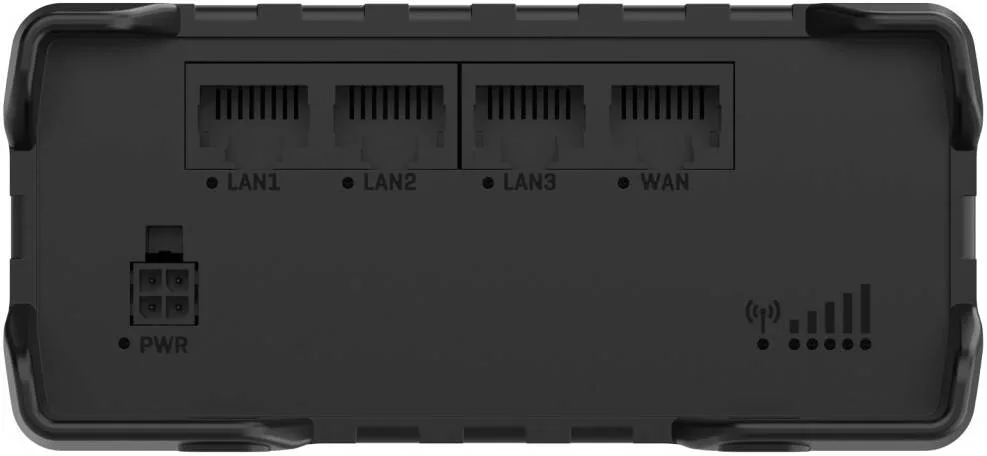
- 1 x WAN port (can be configured to LAN) 10/100 Mbps, compliance IEEE 802.3, IEEE 802.3u standards, supports auto MDI/MDIX
- LAN
- 3 x LAN ports, 10/100 Mbps, compliance IEEE 802.3, IEEE 802.3u standards, supports auto MDI/MDIX
- Routing
- Static routing, Dynamic routing (BGP, OSPF v2, RIP v1/v2, NHRP)
- Network protocols
- TCP, UDP, IPv4, IPv6, ICMP, NTP, DNS, HTTP, HTTPS, FTP, SMTP, SSL v3, TLS, ARP, VRRP, PPP, PPPoE, UPNP, SSH, DHCP, Telnet, SMPP, SMNP, MQTT, Wake On Lan (WOL)
- VoIP passthrough support
- H.323 and SIP-alg protocol NAT helpers, allowing proper routing of VoIP packets
- Connection monitoring
- Ping Reboot, Wget Reboot, Periodic Reboot, LCP and ICMP for link inspection
- Firewall
- Port forward, traffic rules, custom rules
- DHCP
- Static and dynamic IP allocation, DHCP Relay, Relayd
- QoS / Smart Queue Management (SQM)
- Traffic priority queuing by source/destination, service, protocol or port, WMM, 802.11e
- DDNS
- Supported >25 service providers, others can be configured manually
- Network backup
- VRRP, Mobile, Wired and WiFi WAN options, each of which can be used as backup, using automatic Failover
- Load balancing
- Balance your internet traffic over multiple WAN connections
- SSHFS (optional)
- Possibility to mount remote file system via SSH protocol (not available in standard FW)
- Authentication
- Pre-shared key, digital certificates, X.509 certificates
- Attack prevention
- DDOS prevention (SYN flood protection, SSH attack prevention, HTTP/HTTPS attack prevention), port scan prevention ( SYN-FIN, SYN-RST, X-mas, NULL flags, FIN scan attacks)
- VLAN
- Port and tag based VLAN separation
- Mobile quota control
- Set up custom data limits for both SIM cards
- WEB filter
- Blacklist for blocking out unwanted websites, whitelist for specifying allowed sites only
- Access control
- Flexible access control of TCP, UDP, ICMP packets, MAC address filter
- Secure Boot
- Cryptographic integrity check of the each system boot process (available on device with special order code RUT950U072C0).
- OpenVPN
- Multiple clients and server can be running simultaneously, 12 encryption methods
- OpenVPN Encryption
- DES-CBC, RC2-CBC, DES-EDE-CBC, DES-EDE3-CBC, DESX-CBC, BF-CBC, RC2-40-CBC, CAST5-CBC, RC2-64-CBC, AES-128-CBC, AES-192-CBC, AES-256-CBC
- IPsec
- IKEv1, IKEv2, supports up to 4 x VPN IPsec tunnels (instances), with 5 encryption methods (DES, 3DES, AES128, AES192, AES256)
- GRE
- GRE tunnel
- PPTP, L2TP
- Client/Server services can run simultaneously
- Stunnel
- Proxy designed to add TLS encryption functionality to existing clients and servers without any changes in the programs' code
- DMVPN
- Method of building scalable IPsec VPNs
- SSTP
- SSTP client instance support
- ZeroTier
- ZeroTier VPN
- WireGuard
- WireGuard VPN client and server support
- ID range
- Respond to one ID in range [1;255] or any
- Allow Remote Access
- Allow access through WAN
- Custom registers
- MODBUS TCP custom register block requests, which read/write to a file inside the router, and can be used to extend MODBUS TCP Slave functionality
- Supported functions
- 01, 02, 03, 04, 05, 06, 15, 16
- Supported data formats
- 8 bit: INT, UINT; 16 bit: INT, UINT (MSB or LSB first); 32 bit: float, INT, UINT (ABCD (big-endian), DCBA (little-endian), CDAB, BADC)
- Protocol
- HTTP(S), MQTT, Azure MQTT
- MQTT gateway
- Allows sending commands and receiving data from MODBUS Master through MQTT broker
- Supported modes
- TCP Master, DNP3 Outstation
- WEB UI
- HTTP/HTTPS, status, configuration, FW update, CLI, troubleshoot, event log, system log, kernel log
- FOTA
- Firmware update from server, automatic notification
- SSH
- SSH (v1, v2)
- Call
- Reboot, Status, WiFi on/off, Mobile data on/off, Output on/off
- TR-069
- OpenACS, EasyCwmp, ACSLite, tGem, LibreACS, GenieACS, FreeACS, LibCWMP, Friendly tech, AVSystem
- MQTT
- MQTT Broker, MQTT publisher
- SNMP
- SNMP (v1, v2, v3), SNMP trap
- JSON-RPC
- Management API over HTTP/HTTPS
- MODBUS
- MODBUS TCP status/control
- RMS
- Teltonika Remote Management System (RMS)
- Cloud of Things
- Allows monitoring of: Device data, Mobile data, Network info, Availability
- ThingWorx
- Allows monitoring of: WAN Type, WAN IP Mobile Operator Name, Mobile Signal Strength, Mobile Network Type
- Cumulocity
- Allows monitoring of: Device Model, Revision and Serial Number, Mobile Cell ID, ICCID, IMEI, Connection Type, Operator, Signal Strength, WAN Type and IP
- Azure IoT Hub
- Can send device IP, Number of bytes send/received/ 3G connection state, Network link state, IMEI, ICCID, Model, Manufacturer, Serial, Revision, IMSI, Sim State, PIN state, GSM signal, WCDMA RSCP WCDMA EC/IO, LTE RSRP, LTE SINR, LTE RSRQ, CELL ID, Operator, Operator number, Connection type, Temperature, PIN count to Azure IoT Hub server
- CPU
- Mediatek MIPS 24Kc 580 MHz
- RAM
- 128 MB, DDR2
- FLASH storage
- 16 MB, SPI Flash
- Keep settings
- Update FW without losing current configuration
- Operating system
- RutOS (OpenWrt based Linux OS)
- Supported languages
- Busybox shell, Lua, C, C++
- Development tools
- SDK package with build environment provided
- Input
- 1 x Digital input, 0 - 5 V detected as logic low, 8 - 30 V detected as logic high
- Output
- 1 x Digital open collector output, max output 30 V, 300 mA
- Events
- SMS, EMAIL, RMS
- Connector
- 4 pin industrial DC power socket
- Input voltage range
- 9 – 30 VDC, reverse polarity protection; surge protection >31VDC 10us max
- PoE (passive)
- Passive PoE over spare pairs. Possibility to power up through LAN port, not compatible with IEEE802.3af, 802.3at and 802.3bt standards
- Power consumption
- < 2 W idle, < 7 W Max
- Ethernet
- 4 x RJ45 ports, 10/100 Mbps
- I/O’s
- 1 x Digital Input, 1 x Digital Output on 4 pin power connector (available from HW revision 1600)
- Status LEDs
- 1 x bi-color connection status LED, 5 x connection strength LEDs, 4 x LAN status LEDs, 1 x Power LED
- SIM
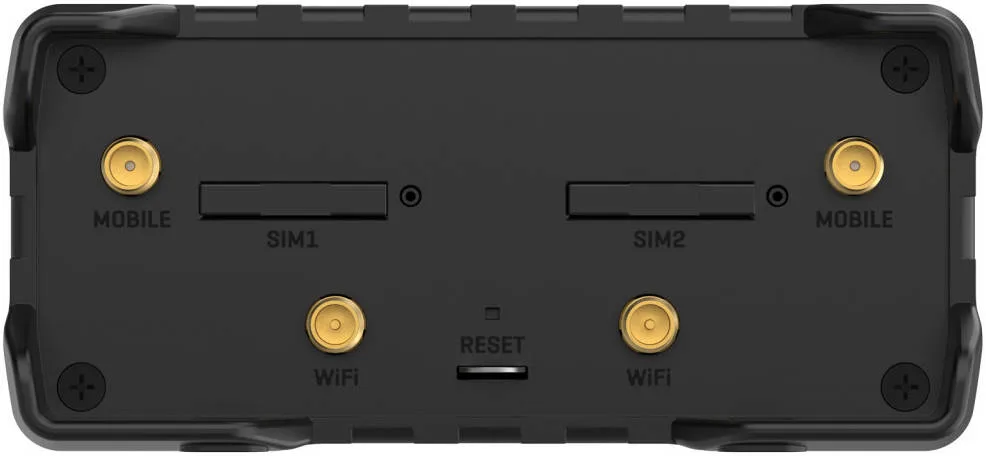
- 2 x SIM slots (Mini SIM - 2FF), 1.8 V/3 V, external SIM holders, eSIM (Optional)
- Power
- 1 x 4 pin power connector
- Antennas
- 2 x SMA for LTE, 2 x RP-SMA for WiFi antenna connectors
- Reset
- Reboot/User default reset/Factory reset button
No reviews yet
Be the first to review this product.
Got something to share?
Rate this product — your experience helps other buyers.