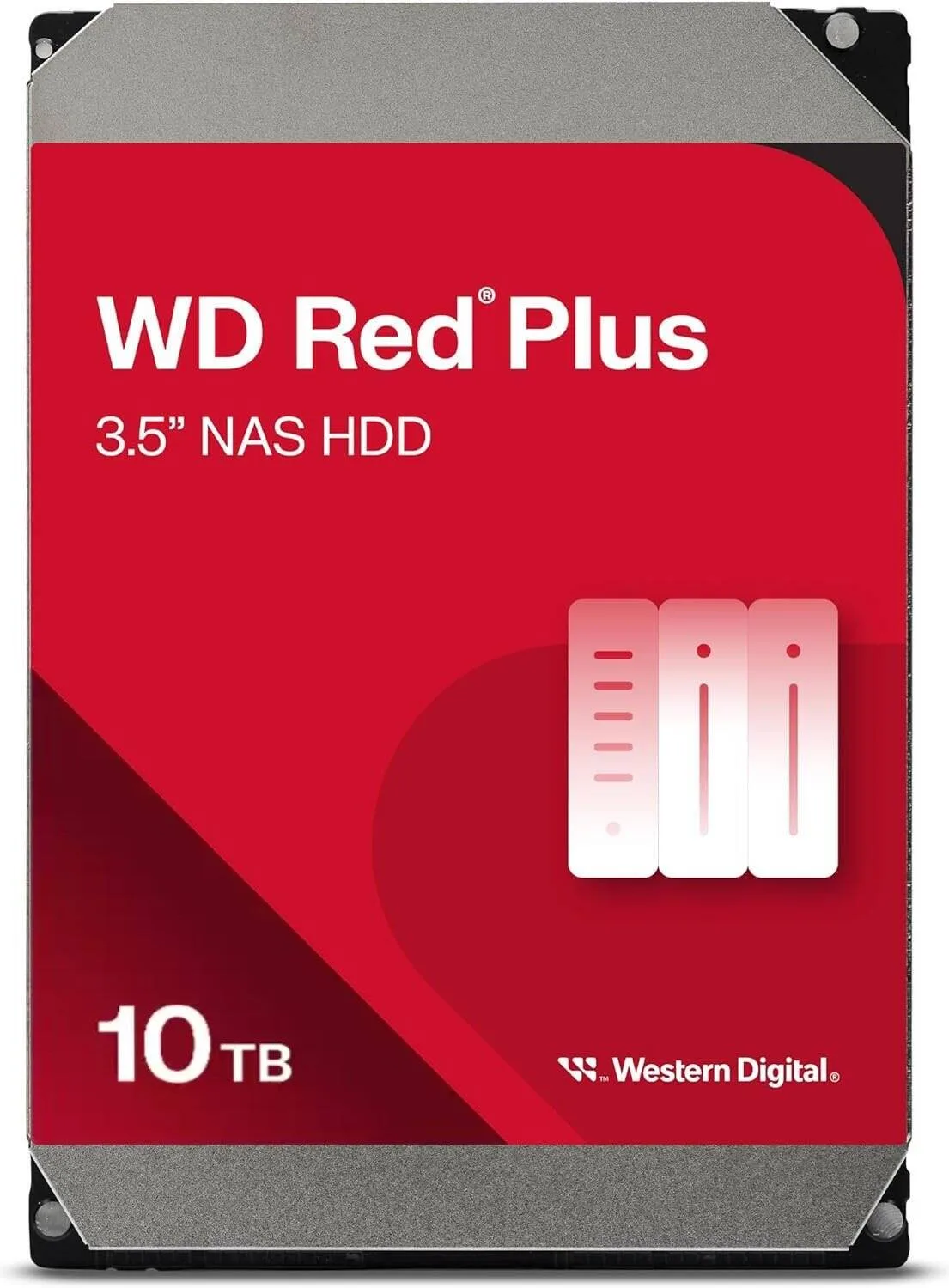

Western Digital Red Plus 3.5" Internal NAS HDD, 10TB Capacity, Up to 260MB/s Transfer Rate, 7200 RPM Disk Speed, 512 MB Cache Size, 180 TBW Endurance, CMR Recording Technology

- Ideal for Home Offices, Power Users, Small to Medium Businesses and Consumer/Commercial NAS systems
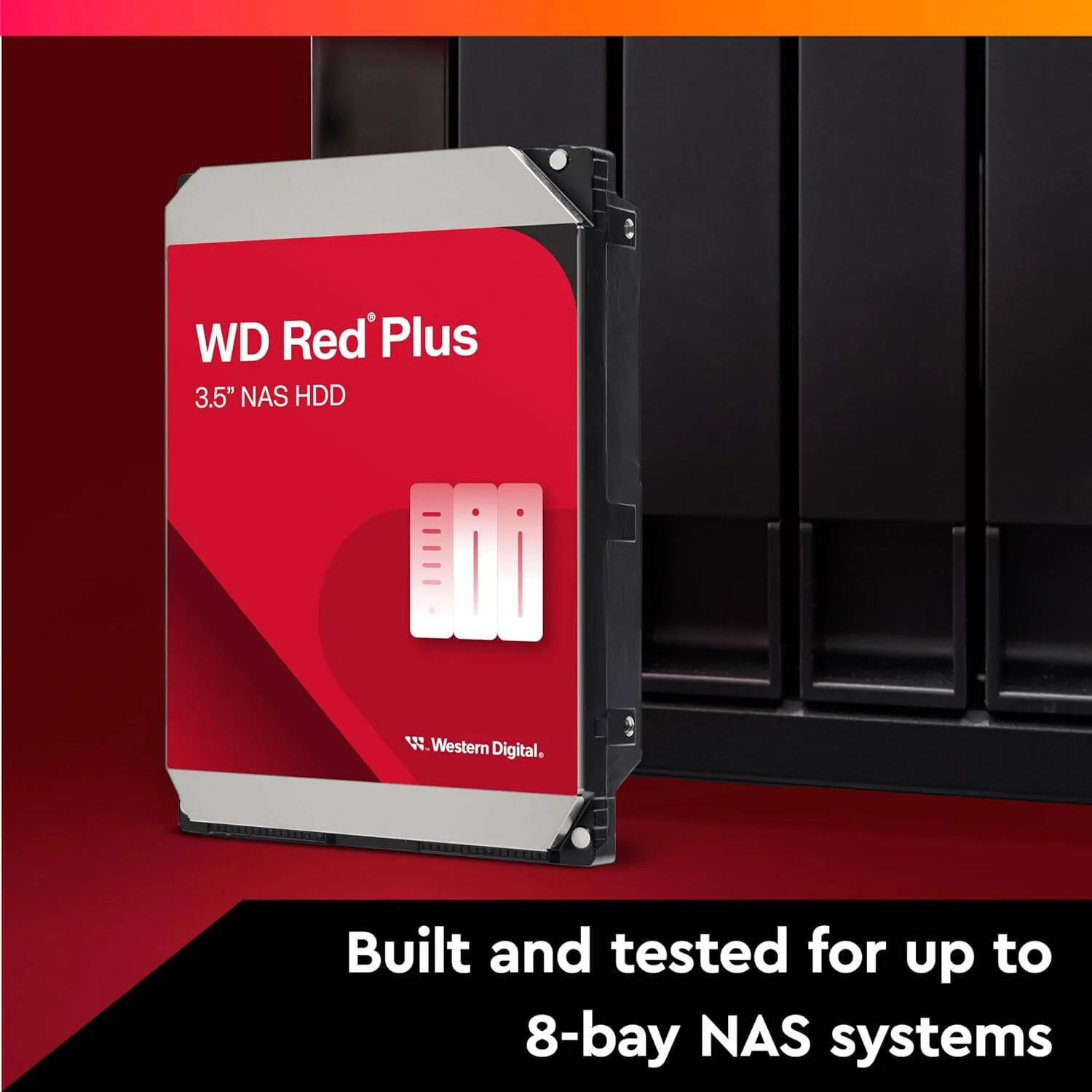
- For RAID-optimized NAS systems with up to 8 bays
- Rated for 180TB/year workload1 and 1M hours MTBF
Warranty: 1 Year — effortless warranty claims with UK-wide coverage. Learn more
Key specifications
- Rpm
- 7200 RPM
- Capacity
- 10 TB
- Form factor
- 3.5"
- Storage type
- Internal Hard Drives
Details
- Shipping Weight
- 0.65 Kg
- Shipping Dimensions
- 3.00 cm x 10.50 cm x 14.00 cm
- Connector
- SATA
- Interface
- SATA
- Transfer Rate
- Up to 260MB/s
- Disk Speed (RPM)
- 7200 RPM
- Recording Technology
- CMR
- Cache Size
- 512 MB
- Endurance (TBW)
- 180 TB/Year
- Dimensions (L x W x H)
- 5.787" x 4" x 1.028"
- Weight
- 1.65 lbs
- Model Number
- WD100EFGX
- Operating Temperature
- 0°C to 65°C
- Non-Operating Temperature
- -40°C to 70°C
- Certifications
- BSMI, ICES-003/NMB-003, CE, FCC, KC, Maghreb, RCM, UKCA, VCCI, CB-Scheme, TUV, UL
4.611 reviews
Got something to share?
Rate this product — your experience helps other buyers.
Maya P. Used for: 3–6 months
Comment
Bought two to build out a second volume for photo backups and the pair have been faultless. What I did not expect was how much cooler they run than the old 6TB drives in the same cage, four degrees lower under the same load, which I put down to the newer platters. The idle power draw is lower too, which on a machine that never gets switched off is worth something
George H. Used for: Less than a month
Comment
Bought to replace a 4TB that was starting to log reallocated sectors, and the swap was painless. The rebuild took nineteen hours which sounds grim until you remember what it is doing. Sustained read on the finished array sits around 190MB/s over the network, which saturates the gigabit link and then some
Isla M. Used for: 3–6 months
Pros
Consistent from unit to unit
Cons
Warm in a packed cage
Comment
Third one I have bought for this box and they have all behaved identically. Good sign
Daisy B. Used for: 1–3 months
Pros
Volume expansion was a one click job
Cons
Spins up loudly out of idle
Comment
Slotted into bay three of the NAS, expanded the volume overnight and that was the whole job. No fuss, no compatibility list nonsense!
Oliver W. Used for: 3–6 months
Pros
Holds above 200MB/s well past half full
Cons
The 7200rpm spin is louder than the old Reds
Comment
Good drive, and I would buy another, but the 7200rpm version is a noticeably different animal to the 5400 ones people remember. In a NAS in a cupboard it makes no odds. Mine sits on a shelf in the office and the seek noise carries. Not a fault, just a thing to know if you were expecting the quiet Red of a few years back. On everything else it delivers. Ten terabytes formats to about 9.09 usable, transfers hold above 200MB/s until the drive is well past half full, and it has been rock solid through three full scrubs.
Thomas L. Used for: More than a year
Pros
Four in one array and not a single dropped disk
Cons
Audible chatter whenever a scrub runs
Comment
Four of these in a Synology running SHR and the array has not had a single dropped disk. That is really all you want from a NAS drive. They are not silent, there is a definite chatter when a scrub runs, but at idle they are quieter than the older Reds they replaced. Over a year of continuous power on hours and the SMART attributes have not moved. Warm at 42 degrees with the stock case fans on the low setting.
Jack N. Used for: More than a year
Pros
SMART attributes are still clean
Cons
Developed a rhythmic tick that will not go away
Comment
Mine developed a rhythmic tick at around the ten month mark. No reallocated sectors, no errors, the array is happy, but the noise is there every few seconds and I notice it every single evening.
George E. Used for: More than a year
Pros
Takes a parity check and a transcode at once without blinking
Cons
Loudest thing in the room at three in the morning
Comment
This drive has been the quiet workhorse of a home server that runs three virtual machines, a media library and the household backups. It went in when the array was down to its last terabyte and it has been powered on almost continuously ever since. Two years and change, if the SMART hours are to be believed, and the only thing that has changed is that the temperature crept up two degrees when I moved the case onto carpet, which was my fault and not the drive's. Throughput is what a good 7200 NAS drive should do. Two hundred megabytes a second on big files, and it is the network that gives up first rather than the disk. It handles being hammered by a parity check and a Plex transcode at the same time without either job noticing. Marked as five because it has earned it, though I will say the seek noise is the loudest thing in the room at three in the morning.
Willow O. Used for: Less than a month
Pros
Recognised by the NAS with no firmware faff
Cons
Vibrates enough to need the rubber mounts
Comment
First 7200rpm drive I have put in this cabinet and the difference in vibration is immediately obvious. It needed the rubber mounts that came with the case, which I had never bothered with before. Performance wise there is nothing to complain about, a big media folder copied across at a steady 205MB/s and the drive was recognised by the NAS without a firmware update.
Noah P. Used for: 6–12 months
Cons
Hard to justify against a shucked external
Comment
Runs as the parity drive in an unRAID box alongside two older disks and it has taken everything thrown at it. Parity checks on ten terabytes take about seventeen hours and the drive does not break a sweat, sitting at 40 degrees the whole way with one 140mm fan on it. Nine months in, zero errors, zero reallocations. The only real gripe is the price gap between this and the equivalent shucked external, which is hard to justify unless you specifically want the warranty and the vibration sensors.
Willow L. Used for: Less than a month
Pros
Passed a full surface check first time
Cons
You pay a premium over a plain desktop drive
Comment
Arrived properly packed in a foam clamshell, formatted in the NAS without a murmur and the full surface check came back clean!