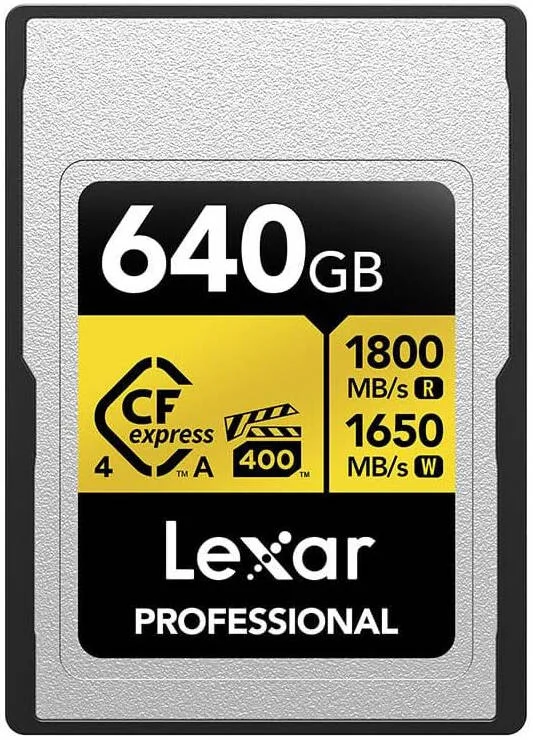
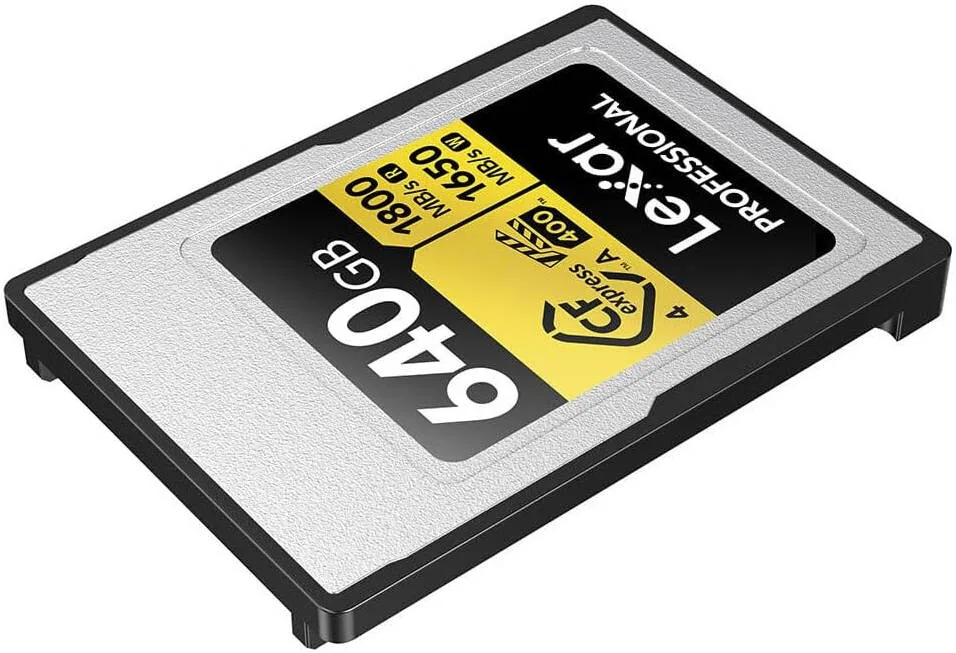
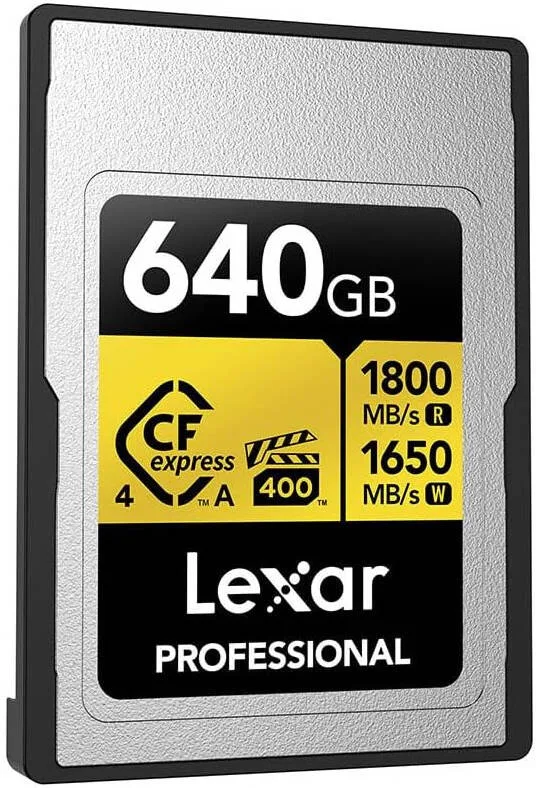
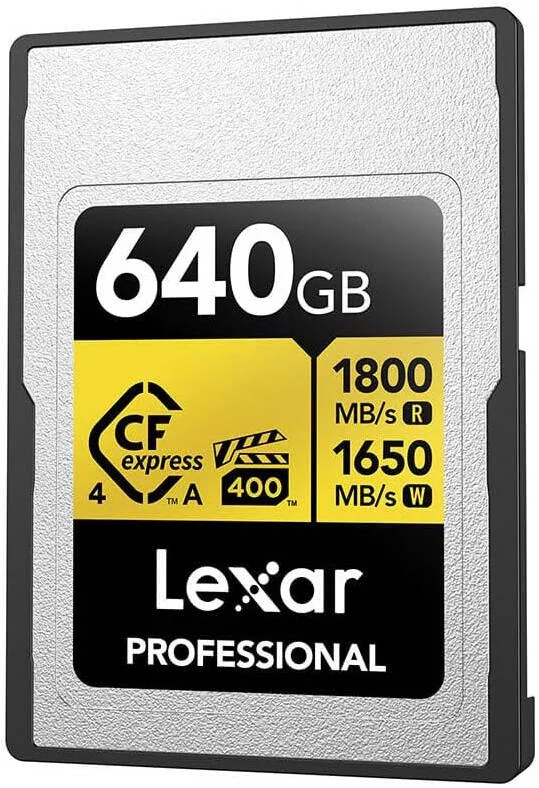
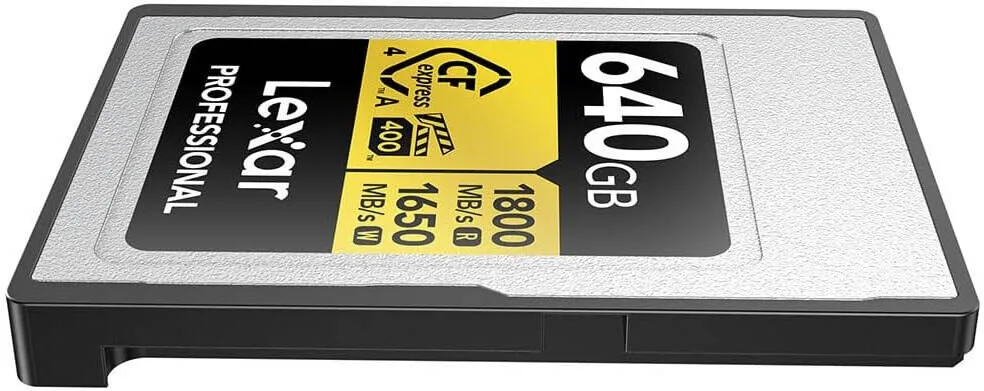
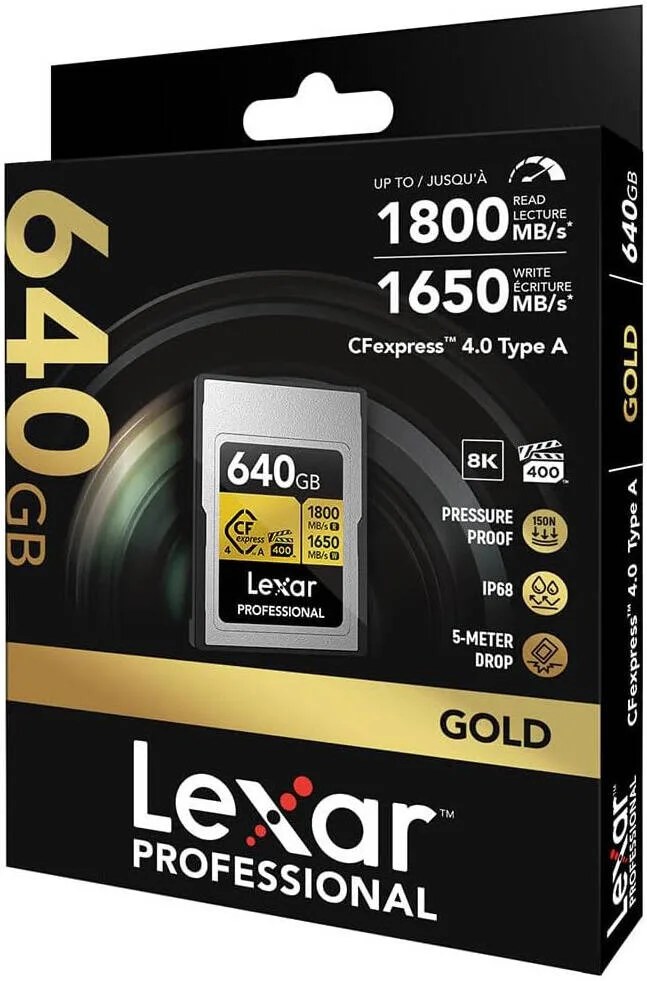
Lexar Professional CFexpress Type A Memory Card 640GB, 8K Video Recording, Professional Photography & Cinema Cameras, Reliable Storage Solution, Grey
- UNMATCHED SPEED - Experience blazing-fast performance with up to 1800MB/s read and 1650MB/s write speeds, drastically reducing file transfer times for demanding workflows.
- CINEMATIC CAPTURE - Capture stunning 8K video with sustained write speeds of 1400MB/s, ensuring smooth, uninterrupted recording for professional-quality results in any environment.
- MASSIVE STORAGE - With a generous 640GB capacity, this CFexpress 4.0 Type-A card provides ample space for high-resolution photos and videos, eliminating the need for frequent card swaps.
Warranty: 1 Year — effortless warranty claims with UK-wide coverage. Learn more
Details
- Shipping Weight
- 0.15 Kg
- Shipping Dimensions
- 3.20 cm x 3.20 cm x 2.40 cm
- Flash Memory Type
- CFexpress
- Memory Storage Capacity
- 640 GB
- Compatible Devices
- Sony Camera
- Additional Features
- Cutting-edge CFexpress 4.0 performance for videography
- Read Speed
- 1400 MB/s
- Media Speed
- 1650 MB/s
- Secure Digital Association Speed Class
- Class 10
- Flash Memory Video Speed Class
- VPG400
4.58 reviews
Got something to share?
Rate this product — your experience helps other buyers.
Amelia K. Used for: More than a year
Pros
Eighteen months of hard use and every card still benchmarks as new
Cons
The plastic case they ship in is useless
Comment
Four of these live in a wallet and go out on every job. Formatted in camera before each shoot, filled most days, and not one has produced a corrupt file or a failed offload in two years of that. The case each one arrives in is a flimsy clamshell that will not survive a bag, so budget for a proper card wallet. Everything else about them has earned the money back several times over.
Rosie B. Used for: More than a year
Cons
One card in three developed a read error on a full offload
Comment
Three of these have been in rotation for over a year and two have been perfect. The third threw a read error part way through copying a shoot, and although a second attempt got everything off, that is not a thing you want to see when the footage only exists in one place. It has behaved since and I have kept it as a B slot card rather than trusting it with anything I cannot reshoot. Four stars, because two thirds perfect is not a bad record and the price reflects it.
Theo P. Used for: 1–3 months
Pros
Considerably cheaper than the Sony cards and just as quick in the camera
Cons
The bundled reader is only USB 3.2 Gen 1
Comment
In an A7 IV it behaves identically to the Sony card it sits beside, same buffer clearing, same recovery after a burst. The reader in the box is the weak link, capped well below what the card can do, so I use a Thunderbolt one instead.
Ella N. Used for: 1–3 months
Pros
Aerial 4K120 with no dropped frames
Cons
The camera reports it as a slower card than it is
Comment
Rigged on a gimbal under a drone with an FX30 shooting 4K120, and the card keeps up without a murmur, which is the only thing that matters when you are paying for flight time. Six weeks and a dozen flights in, not a dropped frame anywhere. One oddity is the speed reporting. The body lists it in a lower class than the label claims and initially refused the highest bit rate until a camera firmware update sorted it. Nothing wrong with the card, but if your body tells you it is too slow, check for a firmware update before you assume the worst.
Ella F. Used for: Less than a month
Pros
Genuinely professional speeds for a lot less than the Sony card
Cons
The Lexar utility is unnecessary and I ignored it entirely
Comment
Bought two of these to take over from a pair of SD cards after moving to an A1, and the difference in how the camera behaves is the whole reason to make the jump. Burst shooting no longer has a ceiling I can hit. Thirty frames a second for as long as I hold the button, and the buffer indicator clears before I have lowered the camera. On video the VPG400 rating means the body will offer the high bit rate modes that it greys out with a slower card in the slot. Two small notes after three weeks and a handful of jobs. The card gets warm, not alarmingly so but noticeably, and there is a utility on the Lexar site that claims to be needed for firmware which I have ignored with no consequence. At this price against the first party cards it is an easy recommendation.
Noah B. Used for: 6–12 months
Pros
VPG400 rating held up on every long take I have thrown at it
Cons
Sustained write is a third slower than the SanDisk equivalent
Comment
For 4K60 and 4K120 on an FX30 it has never caused a dropped frame in nine months, and that is what the rating is for. Where the price difference shows is at the desk. A benchmark puts sustained write around 800MB/s against the 1400 the SanDisk manages, so a full card takes noticeably longer to offload. If your day ends with three cards to copy that adds up, and if it ends with one it does not matter at all.
Willow R. Used for: Less than a month
Pros
Camera formatted it instantly and has not complained since
Cons
Runs hot enough that the camera warns on long takes
Comment
Straight into an A7S III, formatted in the body, and it recorded 4K60 all afternoon without a stutter. The one thing I noticed is heat. The overheat warning came up during a 25 minute continuous take, which it did not with the Sony card in the same slot on the same day, so the card is clearly contributing.
Sophie K. Used for: 1–3 months
Pros
Half the price of the SanDisk and the camera cannot tell the difference
Cons
Offload is the one place you notice where the money went
Comment
Ran both cards side by side on the same shoot, one in each slot, recording simultaneously. In the camera the behaviour was identical, same clip lengths, same buffer recovery, no warnings from either. At the desk the SanDisk finished copying while this one was still going, roughly six minutes against ten for the same amount of footage. That is the entire difference for a substantial saving, and for most people that is the right trade.