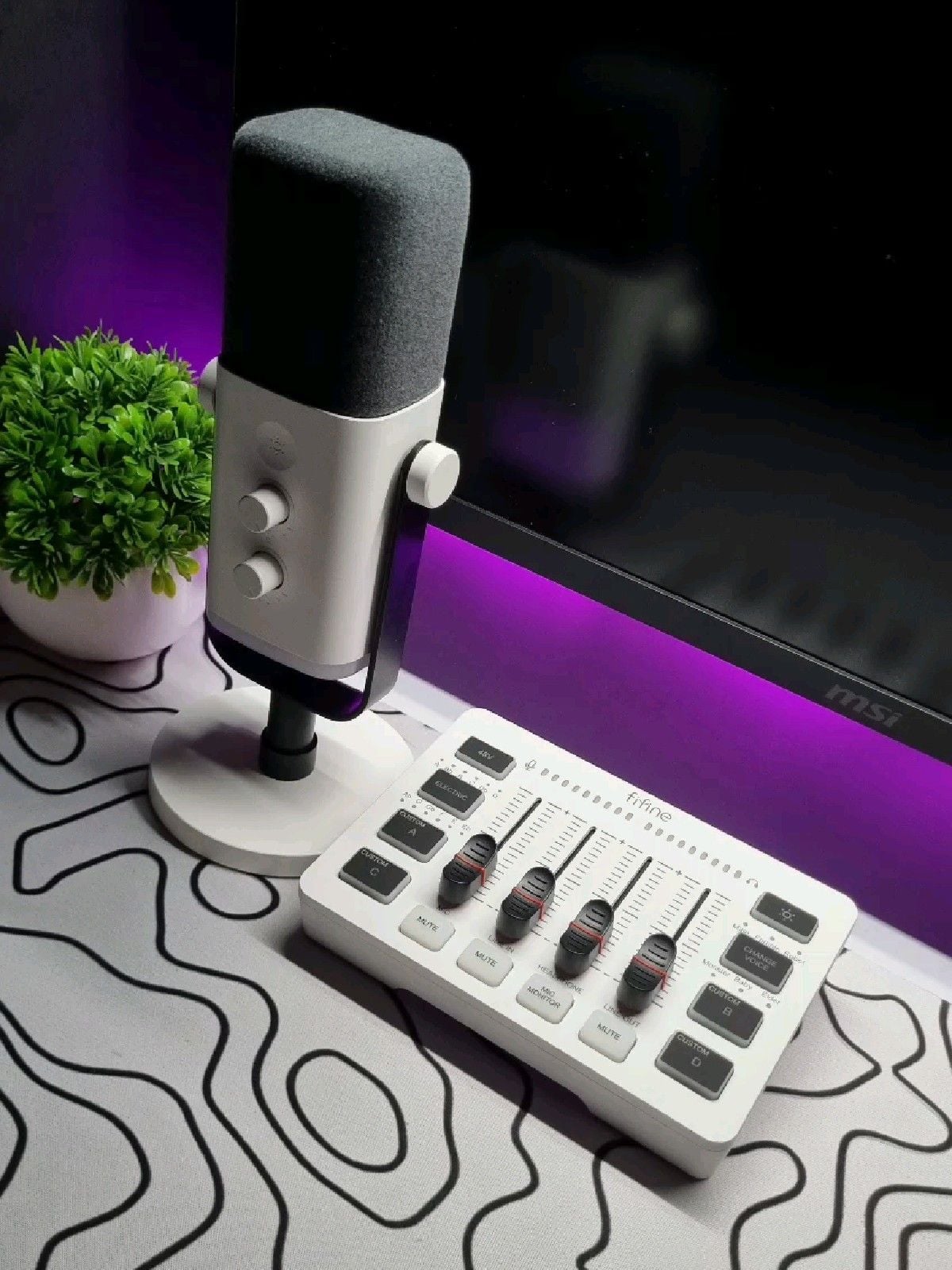
There is a question that arrives in support inboxes every week in some form: I have a USB microphone, which audio interface should I buy to go with it? The answer is that you already bought one. It is inside the microphone, about two centimetres behind the capsule, and there is no socket on the outside that would let a second one help.
Three blocks, one housing
Every recording chain that ends in a computer contains the same three blocks in the same order. A capsule turns air movement into a very small voltage. A preamplifier raises that voltage by something like forty to sixty decibels. A converter samples the result and turns it into numbers.
An XLR microphone contains the first block. The interface on your desk contains the second and third. A USB microphone contains all three, plus the USB controller that carries the numbers, and usually a headphone amplifier as well — the published specification for a Blue Yeti lists a 16-ohm headphone output rated at 130 mW, which is a real amplifier, not a token one.
This is not a compromise hidden in the housing — it is the entire product. A USB microphone is plug-and-play because the three blocks were chosen together by one manufacturer: the gain range matches the capsule's output, and the converter matches the preamplifier's noise floor.
What the housing fixes forever
The cost of that matching is that every one of those choices is now permanent. The published specification of the same Blue Yeti says 48 kHz and 16-bit conversion, a maximum sound pressure level of 120 dB, and a signal-to-noise figure of 100 dB quoted without a reference level, which makes it a marketing number rather than a measurement.
Compare two other USB microphones and the spread is visible at once: a Rode NT-USB is rated to 110 dB maximum sound pressure, a Shure MV7+ to 128 dB over USB. That is an eighteen-decibel range across three products in the same aisle — a factor of eight in pressure. A snare drum at close range or a guitar cabinet will pass 120 dB without effort; a voice at conversational distance will not come close.
The list of things you cannot change afterwards is short and worth reading before you buy rather than after:
- The number of inputs. One capsule, one channel. A second microphone means a second USB device, and two USB microphones on one machine means two clocks running free of each other.
- The conversion. 16-bit at 48 kHz is a decision the housing made, not one you make per session.
- The gain structure. There is a knob, but its range was set to suit the capsule behind it.
- The upgrade path. When you outgrow the capsule you replace the preamplifier and the converter too, because they are screwed to it.
Where the sealed box is the better engineering
None of that makes the sealed box the wrong choice, and there is one case where it is plainly the right one. Dynamic microphones with low output are hard to feed. A Shure SM7B is specified at -59 dBV/Pa, and the manufacturer's own guidance is that speech at three inches needs at least +60 dB of preamplifier gain.
Now look at what the interfaces most often bought alongside it actually deliver: an Audient iD4 gives 58 dB, a third-generation Focusrite Scarlett 56 dB, a Universal Audio Volt 55 dB. All three fall short of the microphone's own requirement, which is why an entire accessory category exists — inline preamplifiers that add roughly +25 dB ahead of the interface, sold for about a third of the price of the interface itself. The fourth-generation Scarlett moved its range up to 69 dB, which reads as a manufacturer conceding the point.
A USB version of a dynamic microphone deletes that whole problem. The preamplifier was specified against the capsule it is bolted to, so the gain is sufficient by construction and there is no mismatch to patch over with an accessory. The sealed box is not the beginner's compromise here — it is the correct piece of engineering, and the XLR path is the one that needs a supplementary purchase to work properly.
What 16-bit actually costs in a real room
The specification most often held against USB microphones is the 16-bit conversion, so it is worth working out what it buys and what it does not. Sixteen bits gives roughly 96 dB between the loudest sample and the quantisation floor. Record a voice with peaks at a sensible -18 dBFS and you have left 78 dB of that range under the signal.
Then ask what is actually sitting in that space. A good large-diaphragm condenser capsule has a self-noise figure somewhere between 11 and 15 dBA, with 16 to 19 dBA regarded as adequate for most work. A quiet domestic room measures around 30 dB SPL, and a room with a computer in it rather more. With a voice peaking near 90 dB SPL at the capsule, the room and the capsule between them occupy the bottom of your range long before the converter's floor becomes audible.
So 16 bits is not what limits a spoken-word recording made in a bedroom. It costs margin for error — a take recorded 20 dB too quietly has less room to be rescued — but it is not why the recording sounds like a bedroom. The room is, and no conversion depth changes that.
The decision, stated plainly
Two paths, and the question that separates them is not quality. It is how many things you expect to change.
The sealed path buys one product that works out of the box, with the preamplifier matched to the capsule. When any part of it stops suiting you, the whole thing is replaced.
The separated path costs more at the start — microphone, interface, cable, stand — and the parts have independent lifetimes. A capsule you like survives three interfaces; an interface with two inputs survives every microphone you will own, gives you phantom power for a condenser, and gives a guest somewhere to sit.
Which produces the recommendation nobody selling accessories wants to make. If you record one voice, alone, and expect to keep recording one voice alone, do not buy an interface to sit next to your USB microphone — there is nothing for it to do, and putting one in the chain adds a conversion stage without adding a capability. Buy the second interface when you have a second thing to plug into it, and let that purchase be the moment you move to an XLR capsule as well.
The check that takes a minute
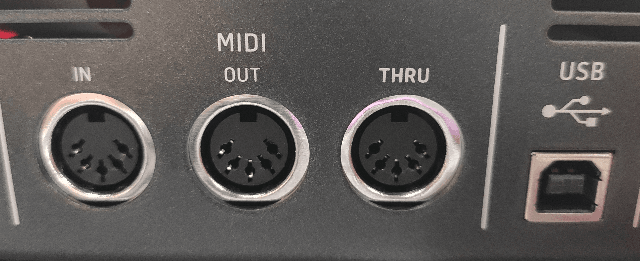
Look at the back of the microphone. If there is a USB socket and a gain control, the preamplifier and the converter are already paid for and already chosen. If there is a three-pin XLR socket and nothing else, the microphone is the only block you own and the other two are still to be bought.
If both sockets are present — a growing number of dynamic microphones offer XLR and USB from the same body — record the same source both ways once, at the same distance, and keep whichever you would rather hear. That comparison answers more than any specification sheet, because it is the only one that uses your room.
How this was put together
Five independent sources sit under the figures above: the published specification for the Blue Yeti, giving 48 kHz and 16-bit conversion, 120 dB maximum sound pressure and a 16-ohm, 130 mW headphone stage; the rated maximum sound pressure levels for the Rode NT-USB and the Shure MV7+ at 110 dB and 128 dB; Shure's own output-level and preamplifier-gain guidance for the SM7B, at -59 dBV/Pa and a minimum of 60 dB; the published gain ranges for the Audient iD4, third and fourth generation Focusrite Scarlett and Universal Audio Volt preamplifiers; the specified gain of the inline preamplifiers sold to bridge that gap; and the self-noise ranges quoted for large and small diaphragm condenser capsules in microphone-specification references.
The derived figures are ours: the 78 dB of usable range left under a -18 dBFS peak in a 16-bit recording, the comparison of that range against capsule self-noise and domestic room noise, and the eight-to-one pressure ratio between the quietest and loudest of the three USB microphones cited.