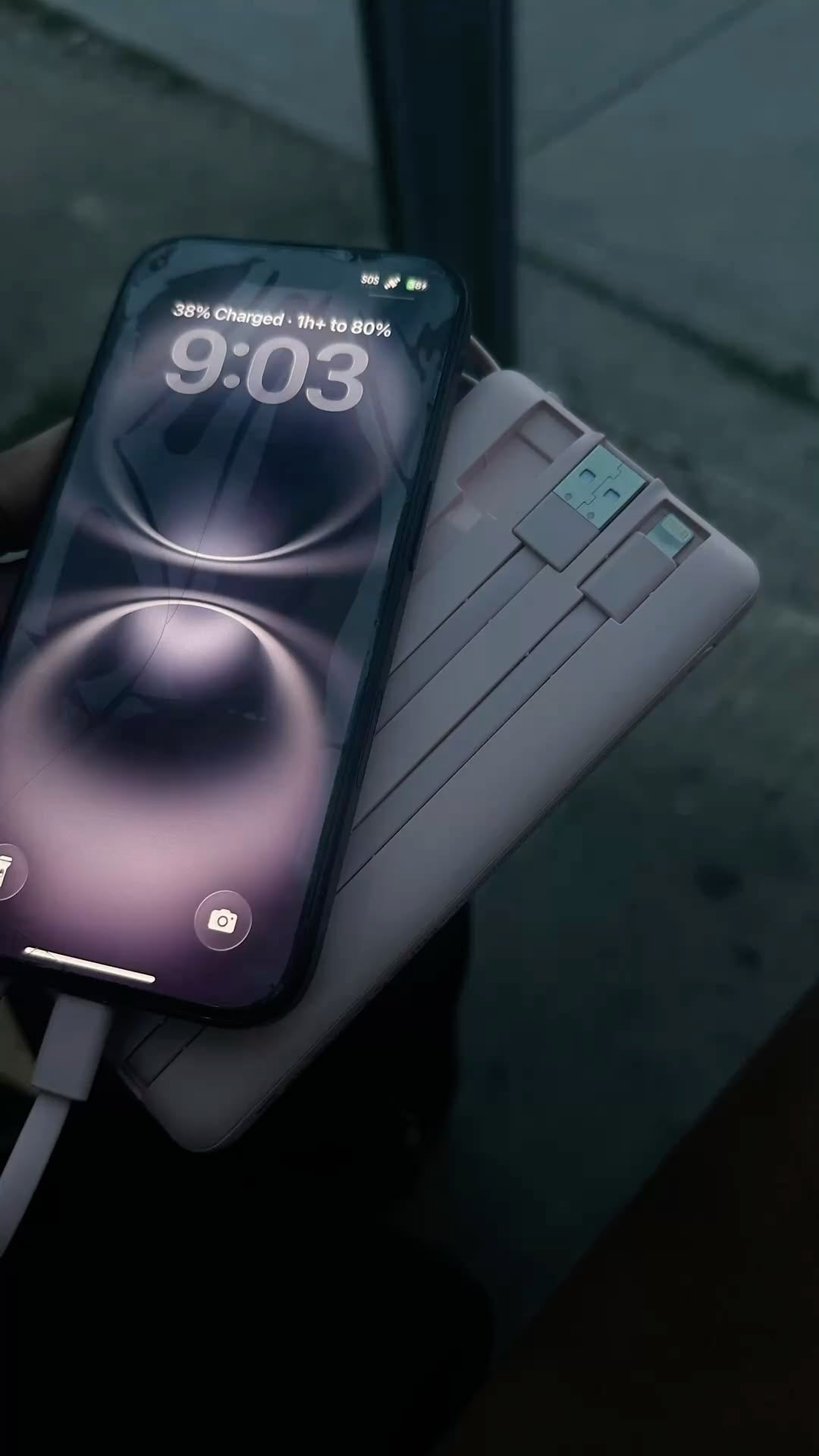
The brick says 65 W. The phone says an hour and a half to eighty per cent. You have used this charger for a laptop and watched it deliver everything it promised, so the slow figure on the lock screen looks like a fault in one of the two devices. It is neither. A USB-C charger and a phone have to agree on a way of talking before any of that power moves, and when they cannot, they fall back to something safe and slow.
Every charge starts at five volts
A USB-C port begins at 5 V, always, for safety — nothing is allowed to arrive at a device that has not asked for it. From there, the two ends negotiate.
Under USB Power Delivery, the charger advertises the fixed voltages it can supply — commonly 5, 9, 15 and 20 V — and the device picks one and asks for a current. A phone might request 9 V at 3 A for 27 W; a laptop asks the same brick for 20 V at 3.25 A. Both are served, at very different powers, from one socket.
If the negotiation fails, the port stays where it started. A plain USB-C connection tops out at 5 V and 3 A — 15 W — and a cable that lacks the configuration wire cannot negotiate at all, which lands you at the slowest option on offer.
Where the agreement usually breaks
There are three common failures, and they look identical from the lock screen.
The phone wants PPS and the charger has not got it. Programmable Power Supply is an optional extension to Power Delivery that lets a device request a voltage in steps of 20 mV and a current in steps of 50 mA, instead of picking from four fixed rungs. Modern phones use it to hold the battery at exactly the voltage its charging curve wants. Without it, a phone rated for 45 W typically settles for 15 to 18 W — not because the charger is weak, but because the fine control it needs is absent.
The phone speaks a proprietary protocol. Several manufacturers use their own schemes, and they are built differently: rather than raising voltage, they push current at low voltage — 5 V at 4 A or 6.5 A, and in later versions 10 V at 6.5 A for 65 W — which moves the heat into the charger instead of the phone. A phone built for that will charge at full speed only on its own brick. On a third-party Power Delivery charger it falls back, commonly to something between 36 and 55 W on the more compatible models, and to 15 W on the rest.
The cable is the limit. Above 60 W, the specification requires the cable to carry an electronic marker declaring it safe for 5 A. Without that marker, the charger assumes 3 A and refuses to go higher — so a 100 W brick and a 100 W phone connected by an unmarked cable negotiate 60 W at best, and a charge-only cable with no configuration wire drops the pair to 5 V.
What the delay is worth in minutes
Put numbers on the outcome, because "slower" is doing a lot of work in the complaint.
A 5 000 mAh phone battery at a nominal 3.85 V holds 19.25 Wh. Charging is not free — conversion and heat lose something like 10 to 20 per cent — so filling it from empty means delivering roughly 22 Wh from the wall.
At the 15 W fallback, that is about 1 hour 28 minutes of ideal charging, and comfortably over two hours in practice, because the last third of any lithium charge tapers as the cell approaches full voltage. At 45 W it is about 29 minutes of ideal charging, which is why manufacturers quote figures like "eighty per cent in half an hour" — eighty per cent is where they stop the clock, precisely because the taper begins.
So the gap between a negotiation that succeeds and one that fails is not marginal. It is the difference between topping up over a coffee and leaving the phone for the evening, on identical hardware, with the same 65 W brick on the table.
What to buy, and what not to
- Match the protocol, not the wattage. A 30 W charger with PPS in your phone's voltage range will charge it faster than a 100 W charger without it. The number on the front of the brick is the ceiling for a laptop, not a promise to your phone.
- Read the label on the back. Chargers print their profiles: 5 V 3 A, 9 V 3 A, 15 V 3 A, 20 V 3.25 A, and, if present, a PPS line with a voltage range. That line is the specification that decides your charging speed.
- Keep the cable that came with the phone. If the phone charges fast on it and slowly on the one from the drawer, you have found an unmarked or charge-only cable rather than a charger problem.
- For a proprietary-protocol phone, keep the original brick for the bedside. The travel charger can be a good PPS unit for everything else; the manufacturer's own is the only one that will reach the advertised peak.
- Beware multi-port bricks. A 65 W charger with three sockets usually splits its budget when more than one is occupied, and the phone is rarely the port that wins.
The purchase this does not justify
Do not buy a bigger charger to fix a slow phone. If the negotiation is failing, 140 W will fail in exactly the same way as 65 W, and you will have paid for headroom that the handshake never reaches. Buy on the profile list instead — and if the phone uses a manufacturer-specific scheme, accept that no third-party brick will match its own, and stop shopping for one.
The one accessory worth replacing on sight is the cable. An e-marked 5 A cable costs little, removes the most common single cause of a capped negotiation, and is the only part of this chain you can fix without knowing anything about protocols.
The check that takes a minute
Turn the charger over and read its output table. If there is no PPS line and your phone is a recent Android, you have your answer. Then swap in the cable that came with the phone and watch the estimate on the lock screen — if the time drops sharply, the cable was the limit.
For certainty, a USB power meter costs less than a takeaway and sits between charger and cable, showing the voltage and current actually negotiated. Seeing 5 V and 2 A on the display, with a 65 W brick behind it, is the whole story of this article in one reading.
How this was put together
Five independent sources sit under the figures above: the USB Power Delivery specification's fixed voltage rungs of 5, 9, 15 and 20 V with up to 5 A, and the 15 W ceiling of an unnegotiated USB-C connection; the PPS extension's 20 mV and 50 mA adjustment steps, together with reports of phones capped near 15 to 18 W on non-PPS chargers against 45 W with PPS; published behaviour of proprietary high-current schemes, including 10 V at 6.5 A for 65 W and fallbacks of roughly 36 to 55 W on third-party chargers; the electronic-marker requirement for cables carrying more than 3 A, without which a charger assumes 60 W maximum; and battery-energy conversion figures giving 19.25 Wh for a 5 000 mAh cell at 3.85 V, with charging efficiency of 80 to 90 per cent.
The derived figures are ours: the roughly 22 Wh that must leave the wall to fill that cell, and the resulting charge times of about 1 hour 28 minutes at the 15 W fallback against about 29 minutes at 45 W — before the taper that makes every manufacturer quote eighty per cent rather than a hundred.