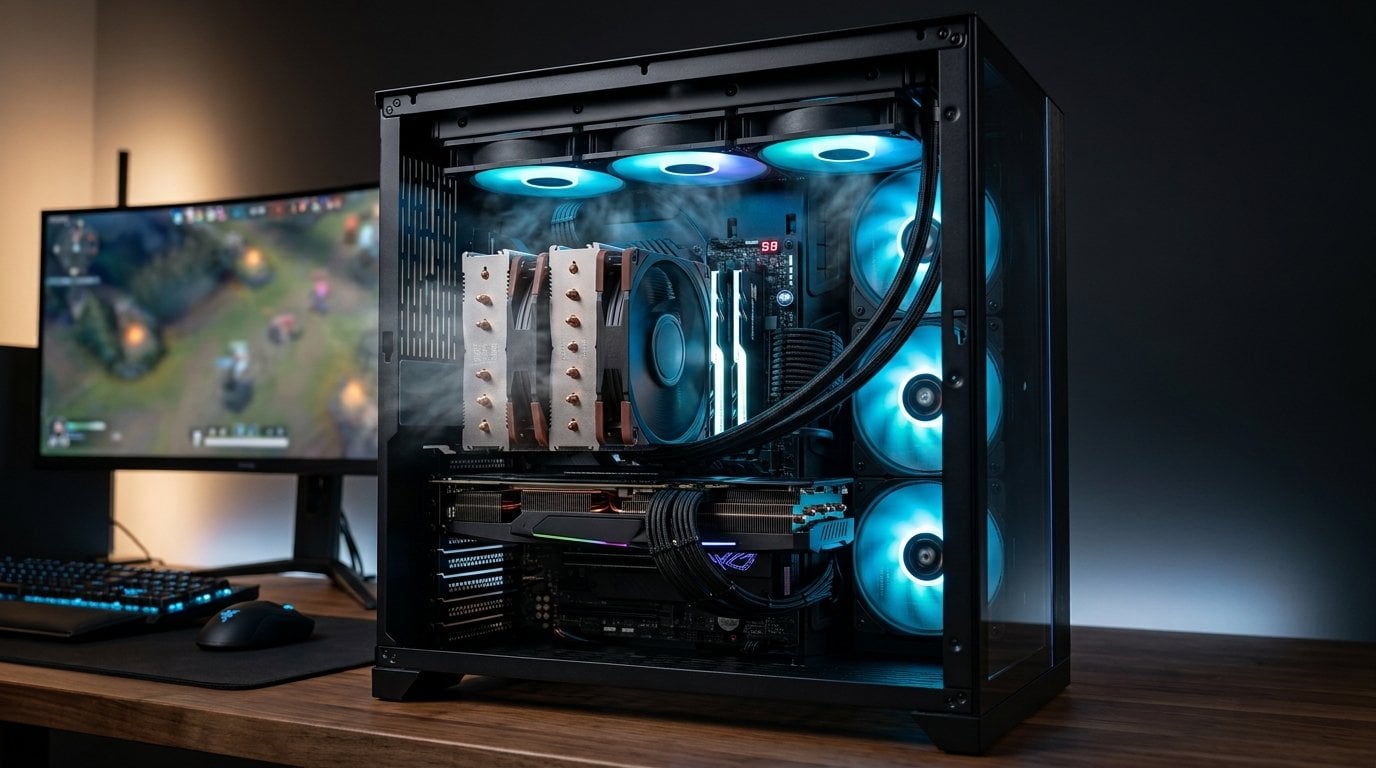
The case says it accepts a cooler up to 165 mm. The cooler says it is 158 mm. It went onto the socket without touching anything, you tightened it down, and the side panel now stops about four millimetres short of closing.
Both numbers were correct. They were measured from different places, and the gap between those places is where your build is currently stuck.
What the case number is measuring
A case's cooler clearance figure is the distance from the surface of the motherboard tray to whatever the side panel presents at that point. It is a single number describing a space that is not the same everywhere.
Three things routinely make the real distance smaller than the published one:
- The panel is not flat. Tempered glass sits in a frame, and the frame's inner lip can intrude several millimetres at the edges. A panel with a fan bracket, a filter, or a small bulge for cable routing eats more.
- The number may be measured to the frame rather than to the glass. Which surface a manufacturer chose is rarely stated.
- The tray is not the reference the cooler uses. The board sits on standoffs above the tray, so the board's own surface is already a few millimetres up.
None of this makes the specification a lie. It makes it a figure with an unstated tolerance, and the sensible working assumption is that you have five millimetres less than it says.
What the cooler number is measuring
The cooler's height is measured from its base — the surface that meets the processor — to the top of the fin stack. That is an honest number and it is not the number that matters, because a tower cooler is not just its fin stack.
The fan is the problem. It clips to the side of the tower, and where it clips is adjustable, because it has to clear whatever is in the memory slots next to it. Fit tall memory with a heatsink and decorative top, and the fan has to ride up — commonly five to ten millimetres above where the specification assumed it would sit.
Now the arithmetic that this article exists for:
- Cooler as specified: 158 mm
- Fan raised to clear tall memory: +10 mm → 168 mm
- Case as specified: 165 mm, minus the frame and glass: ≈160 mm real
Eight millimetres short, from two numbers that appeared to leave seven millimetres spare. Nobody misprinted anything.
The other three clearances nobody checks
Memory height
Manufacturers publish a memory clearance figure for each cooler — the maximum module height that fits under the fan in its normal position. It is a separate number from the cooler's height and it is the one that decides whether the fan has to move at all. Check it against your kit's height, which the memory vendor also publishes, and prefer low-profile modules for any build where the cooler is close to the limit.
The first expansion slot
A wide cooler can overhang the top expansion slot. It rarely blocks it outright, but it can make the graphics card's retention clip unreachable, or foul the card's backplate. On small boards this is a real constraint rather than a theoretical one.
The regulator heatsink
The finned block above the socket has grown considerably, and on some board and cooler combinations the cooler's fins overhang it or the mounting bracket fouls it. Both vendors publish dimension drawings; a build that is going to be tight is worth ten minutes with both of them.
Radiators have their own version of this
The same measurement problem appears in liquid cooling, dressed differently.
A case that states support for a 360 mm radiator in the front is usually quoting the mounting length, not the depth available. The depth you need is the radiator's thickness plus its fans — commonly 27 mm and 25 mm, so around 52 mm before anything else — and what that depth runs into is the front of the motherboard, the memory slots, or a drive cage that is bolted in rather than optional.
Top mounting has the same trap from the other direction: the radiator and its fans hang down into the case and can foul the memory or the board's top heatsinks. Cases publish a maximum board-to-radiator clearance for this; kits publish their thickness. Both numbers exist and neither is on the front of the box.
The measuring method is the same one as above. Fit the board, hold a ruler where the radiator will sit, and read what is actually there.
Measure your own case, once
The reliable method takes two minutes and removes every uncertainty above.
- Install the motherboard, with nothing on the socket.
- Stand a ruler on the board's surface next to the socket — not on the tray.
- Close the side panel gently and read where its inner face lands.
- Subtract three or four millimetres for comfort and airflow. That is your real budget, in your case, on your board.
Then compare it against the cooler's height plus however far the fan will have to rise for your memory. That is the whole calculation, and it is the only version of it that uses two numbers measured from the same place.
If it does not fit
- Move the fan down and accept it overhangs the memory — possible if the modules are short enough, and worth checking before anything else.
- Move the fan to the other side of the tower, pulling instead of pushing. Costs a little performance and often solves the height entirely.
- Swap to low-profile memory. The heatsinks on tall kits are largely decoration; the modules underneath are the same height as any other.
- Run the cooler without its front fan, relying on a case fan behind it. This works better than it sounds on a large tower in a well-ventilated case.
- Change the cooler, and only then the case.
What we would not buy
A cooler whose specified height is within five millimetres of the case's specified clearance. That is not a margin, it is a coincidence waiting to fail, and the failure is discovered at the end of a build rather than at the beginning of one.
And tall memory for a build with a large air cooler. The heatsinks on those kits do nothing thermally that matters at desktop speeds, they are chosen for how they look through the glass, and they are the single most common reason a cooler that fits on paper does not fit in the case.
How this was put together
The clearance figures and their reference points come from the manufacturers' own dimension drawings — cooler makers publish both an overall height and a separate memory-clearance figure, and case makers publish a maximum cooler height whose measuring point is usually left unstated. The memory module heights are published by the kit vendors. The relationship between them, and the ways a published clearance overstates the usable space, is the ordinary experience of anyone who has built into a glass-sided case.
The derived arithmetic is ours: a 158 mm cooler whose fan rises 10 mm for tall memory becomes 168 mm, against a 165 mm case that realistically offers about 160 — eight millimetres short from a pair of numbers that looked like they had seven to spare.