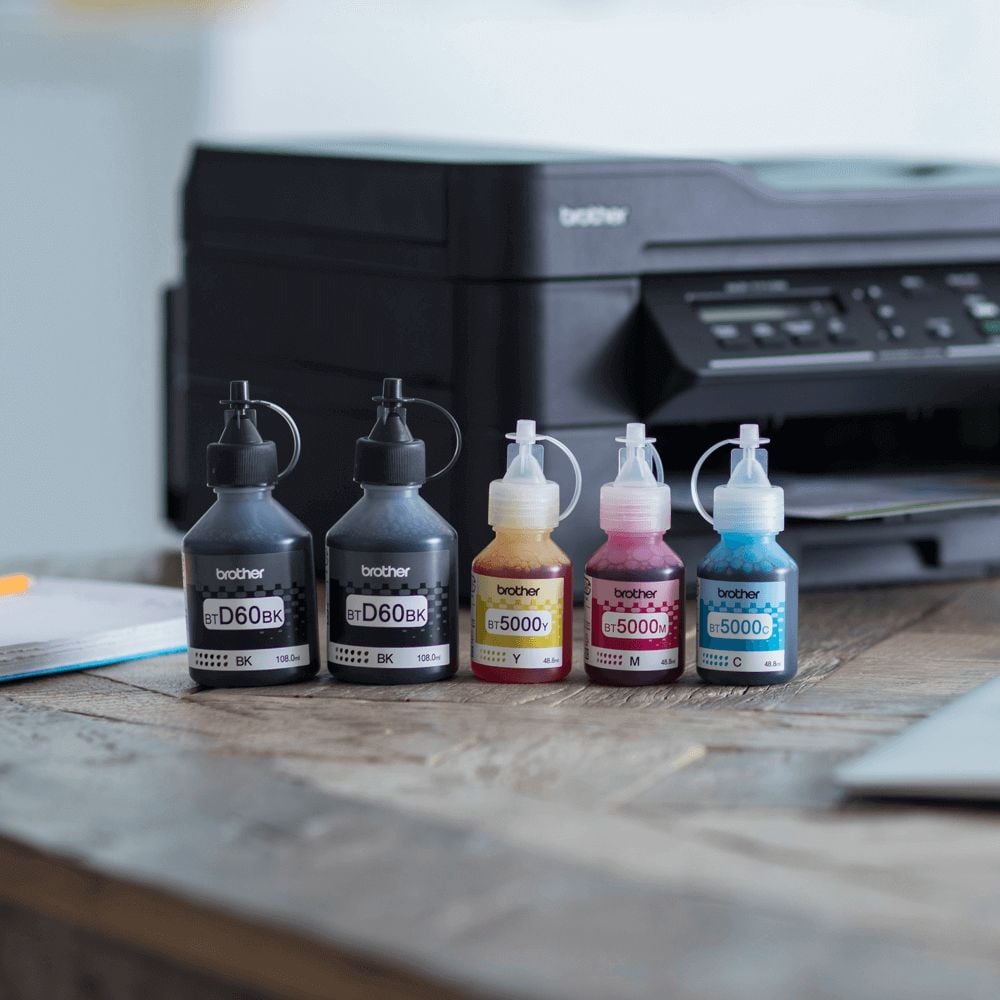
Two printers sit on the same shelf. One costs about sixty pounds and prints from cartridges. The other is a refillable tank machine at two hundred and fifty, and it looks like an indulgence — four times the price for the same job at the same speed. The gap is real, and so is the reason it exists: you are not comparing two printers, you are choosing which end of the transaction pays for the ink.
The machine is not the product
Cartridge printers are sold on thin margins and earn their money on consumables. That is the whole design, and the pricing of the ink follows from it rather than from what is inside the bottle.
Measured by volume, cartridge ink is one of the most expensive liquids a household buys. Published comparisons put brand-name cartridge ink somewhere between £350 and £2 500 per litre depending on the model, with individual small tri-colour cartridges working out near £8 000 per litre when the price is divided by the few millilitres inside. It is routinely more expensive per millilitre than champagne or perfume, and the comparison is made so often precisely because it keeps being true.
Some of that price is real engineering — pigment chemistry, surfactants, anti-clog formulation, and on many designs a print head built into the cartridge itself, which you throw away and re-buy with every refill. The rest is the business model. The tank printer moves the same money to the front of the transaction and sells you ink in bottles at something close to what ink costs.
What a page actually costs
Cost per page is the only number that matters here, and it is easy to compute from figures that are printed on the box.
A standard black cartridge yields 200 to 400 pages. At typical UK prices that lands black-and-white printing at roughly 5 to 10 pence a page. Colour runs far higher — published figures for cartridge machines cluster around 15 to 20 pence for a colour page. And the cheapest printers are the worst offenders, because the cartridges in the box are "setup" units yielding as little as 150 to 250 pages, which pushes the real cost per page above ten pence from the first day.
Tank machines invert this. Bottles are sold in tens of millilitres for single-figure sums, and manufacturers claim savings up to 95 per cent against cartridges. Independent cost-per-page work on tank machines puts colour pages under two pence, and black-and-white printing well below one.
The current UK shelf gives the other half of the comparison: refillable machines from about £240 for an entry model to £320 and £370 for the multifunction ones people actually buy, against cartridge multifunctions at £60 to £100.
The crossover, worked out
Here is the arithmetic the shelf will not do for you. Take a £180 difference in purchase price — a £250 tank machine against a £70 cartridge one — and a difference in running cost.
- Mostly black text, cartridge at 6 p and tank at 0.5 p: you save 5.5 p a page, so the machine pays for itself at about 3 300 pages.
- Mixed text and colour, cartridge at 10 p and tank at 1.5 p: you save 8.5 p, and the crossover falls to roughly 2 100 pages.
- Heavy colour, cartridge at 18 p and tank at 2 p: 16 p saved a page puts the crossover near 1 100 pages.
Now convert those page counts into the unit the headline uses. A set of tank bottles typically covers a few thousand pages, so the mixed-use crossover at 2 100 pages arrives somewhere around the point where you are opening your third set of bottles — and for heavy colour printing, before that. For light black-only printing it can be later, which is the honest version of the claim rather than the marketing one.
Then convert them into time, which is where the decision actually gets made. At 20 pages a month — a household that prints tickets and the odd form — 2 100 pages is nine years, and the machine will not survive to reach it. At 100 pages a month, it is under two years. At 300, about seven months.
What else the cartridge machine spends
Two costs never appear in a cost-per-page table and both favour the tank machine for anyone printing irregularly.
The first is maintenance ink. Inkjets clean their heads on power-up and after idle periods, and consumer testing has found that a significant share of the ink you buy is consumed this way rather than reaching paper. On a cartridge machine, that ink is being spent at cartridge prices; on a tank machine, at bottle prices.
The second is amortisation. Spread the purchase over the pages you will actually print and the machine adds 1 to 3 pence a page for a low-volume household — and effectively nothing for a heavy one. This term is why the crossover arithmetic above is not the whole story: at twenty pages a month, the printer's own cost dominates the ink entirely, and the correct answer may be neither machine.
The two escape routes from cartridge pricing
People rarely pay the sticker price for cartridge ink, and both of the ways around it change the arithmetic above.
The first is third-party and refilled cartridges, which cost a fraction of the original and turn a ten-pence page into a two or three-pence one. What you give up is predictability. Manufacturers authenticate cartridges with chips, firmware updates have repeatedly disabled third-party units, and the machine may refuse to report ink levels or to print at all until an original is fitted. It works, it works well for many people, and it is a running argument with your own printer rather than a settled cost.
The second is an ink subscription, where you pay monthly for a page allowance and the manufacturer posts cartridges before you run out. On the right tier this reaches around 2.5 pence per colour page — genuinely competitive with a tank machine, and far below unsubsidised cartridges. The costs are structural rather than financial: pages do not always roll over, printing more than your tier costs extra, the printer needs a permanent internet connection, and cartridges can stop working if you cancel. You are renting the ability to print.
Both routes tell you the same thing about the cartridge machine. Its advertised running cost is so far above the alternatives that an entire industry exists to avoid paying it, and the choice between a tank machine and a cartridge one is really a choice between paying once at the till and managing a relationship with a consumables business for years.
Where the tank machine loses
The tank design has one genuine weakness and it is the mirror image of its strength. The print head is part of the printer, not part of the cartridge. On a cartridge machine, a clogged head is often replaced automatically with the next cartridge; on a tank machine a badly clogged head is a repair, and on inexpensive models a repair that costs more than the machine.
That risk is a direct function of how often you print. Ink left standing in fine nozzles and tubes for months is what clogs them, so the household that prints twice a year — exactly the household that would take nine years to reach the crossover — is also the one most likely to find the machine unusable when it finally needs it.
There are two smaller trade-offs worth knowing. Tank machines are physically larger, because the tanks have to go somewhere. And the ink in them is often dye-based for colour, which is less water-resistant than the pigment inks in some cartridge lines — irrelevant for homework, relevant for anything that might get wet.
Choosing by volume rather than by principle
Under about 20 pages a month. Buy neither, if you can bear it: a print shop charges pennies a page and never clogs. If you must have a machine in the house, a cheap mono laser is the honest answer — toner does not dry out, and a starter cartridge will last years.
20 to 100 pages a month, mostly black. A mono laser still wins on running cost and on tolerance of neglect. Choose a tank machine here only if you genuinely need colour.
50 pages a month or more with colour in it. This is the tank machine's case, and it is a strong one. The crossover arrives in one to three years, the ink cost per page stops being a consideration, and printing something in colour stops feeling like a decision.
Photographs. Neither of the above. Photo printing is a different specification — more inks, pigment sets, paper handling — and cost per page is the wrong axis to shop on.
The purchase to think twice about
Do not buy a tank printer if you print less than once a month. You are paying a two-hundred-pound premium to avoid an ink cost you will never accumulate, on a machine whose main failure mode is being left idle — and the arithmetic above says the crossover sits the better part of a decade away.
Equally, do not buy the sixty-pound cartridge machine if you already know you print regularly. It is the more expensive machine in every sense that matters after the first six months, and the setup cartridges in the box are sized to make sure you find that out quickly.
The check that takes a minute
Find last year's printing. Most machines report a lifetime page count in their settings or on a status page — divide by the years you have owned it and you have your real monthly volume, which is almost always lower than the one you would have guessed.
Multiply that by twelve, then by the difference in cost per page from the list above, and you have your annual saving. Divide the price difference between the two machines by that saving, and you have the number of years until the expensive one becomes the cheap one. If the answer is longer than you expect to keep a printer, the shelf has just answered the question for you.
How this was put together
Five independent sources sit under the figures above: published comparisons of cartridge ink priced by volume, ranging from several hundred to several thousand pounds per litre, with individual tri-colour cartridges at the extreme; cartridge yield figures of 200 to 400 pages for standard units and 150 to 250 for the setup cartridges shipped with budget machines; cost-per-page work putting cartridge colour pages near 15 to 20 pence and tank colour pages under two; current UK retail pricing for refillable tank multifunction machines between about £240 and £370; and consumer testing showing that a meaningful share of purchased ink is consumed by head-cleaning cycles rather than printing, alongside published amortisation of 1 to 3 pence a page for low-volume users.
The derived figures are ours: the three crossover points — about 3 300, 2 100 and 1 100 pages for black-mostly, mixed and heavy-colour printing against a £180 price difference — and their translation into time at 20, 100 and 300 pages a month, which is what turns a shelf comparison into a decision about your own household.