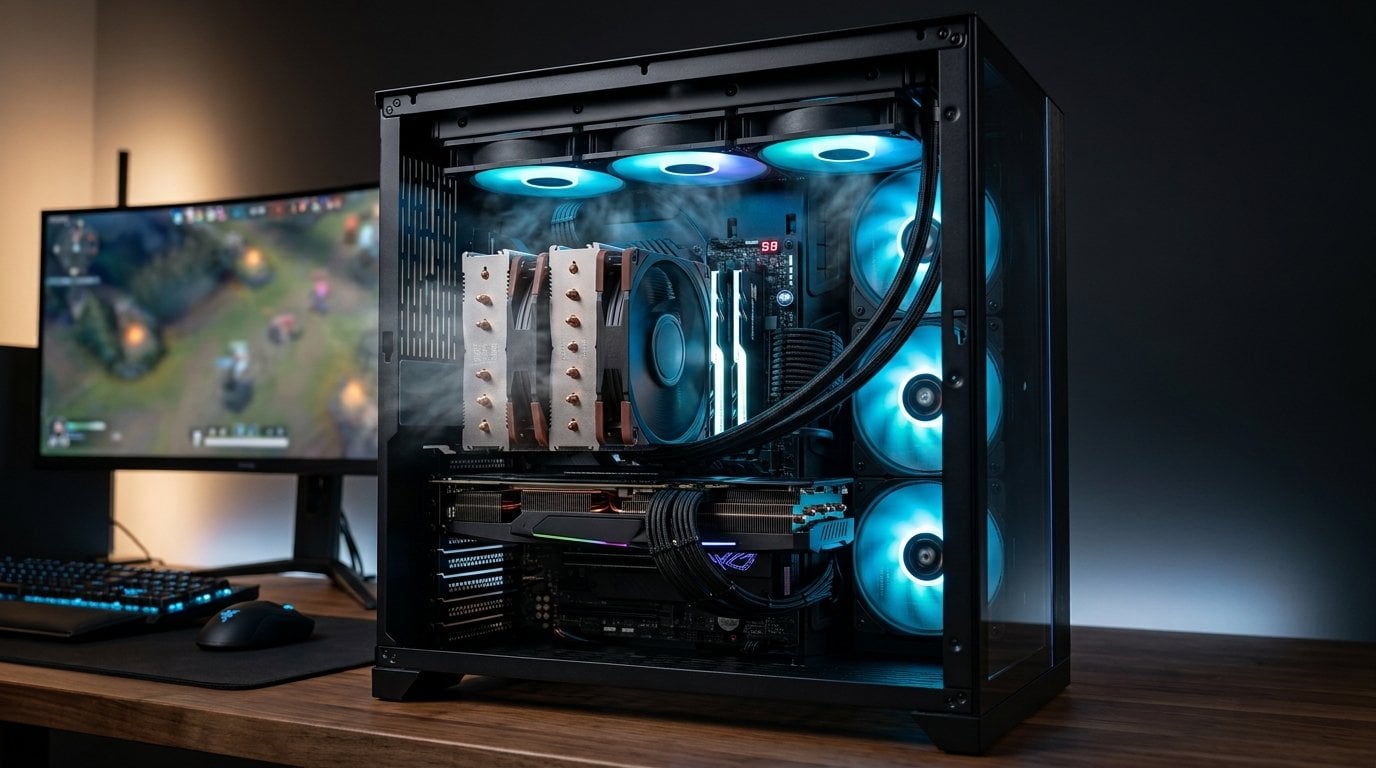
Two coolers, side by side in a review. One is visibly half again the metal of the other, with two more heatpipes and a second fan. The chart separates them by three degrees.
This is the normal result, not an anomaly, and it is worth understanding why — because it decides whether the money you are about to spend buys temperature, noise, or nothing at all.
A cooler is a chain, and chains have weakest links
Heat leaves a processor by passing through a series of stages, each of which resists it. Thermal resistance is measured in kelvin per watt: how many degrees of temperature difference it takes to push each watt through. The stages sit in series, so their resistances simply add, and the total temperature rise is:
ΔT = power × total resistance
Written out, the chain from a modern desktop processor to the room looks roughly like this. Treat the figures as a working model rather than a measurement of your particular part — the shape is what matters:
- Die to heat spreader, through the processor's internal joint — about 0.03 K/W
- Paste and the contact with the cooler's base — about 0.02 K/W
- Base into the heatpipes — about 0.01 K/W
- Along the heatpipes as vapour — about 0.01 K/W while they are working
- Fins to the air — 0.08 to 0.12 K/W
Total: somewhere around 0.15 to 0.19 K/W. Put 250 W through that and you get 37 to 48 degrees above the air entering the fins, which is why a heavily loaded processor with a good cooler in a 22-degree room sits in the sixties and seventies rather than anywhere alarming.
Which link a bigger cooler actually improves
Look at the list again and notice how lopsided it is. The last stage — fins to air — is between half and two thirds of the whole chain. It is also the only one a bigger cooler meaningfully changes.
The first two are fixed by the processor and your paste. Nothing you bolt on top alters how heat gets from the silicon to the top of the heat spreader. Call those fixed stages 0.06 K/W between them, and at 250 W they are 15 degrees you can never remove, with a perfect cooler, an infinite radiator, or liquid nitrogen.
Now suppose you buy a fin stack that is genuinely 30 per cent better — more area, better airflow, a real engineering improvement rather than more mass. The fin resistance falls from 0.10 to 0.07, so the total goes from 0.16 to 0.13.
At 250 W, that is 40 degrees becoming 32.5. A thirty per cent improvement in the one stage you paid for shows up as a seven and a half degree improvement overall — and that is the optimistic case, where the improvement is real.
This is the entire phenomenon. Not diminishing returns in some vague sense: a specific, calculable dilution, because you are improving one term in a sum that has fixed terms in it.
Why more fins stop being more cooling
The fin stack does not scale linearly either, for two independent reasons.
Fin efficiency. Heat has to travel from the base of a fin out to its tip by conduction through thin metal, and it loses temperature along the way. Past a certain length the tip is barely warmer than the air around it, and a surface that is the same temperature as the air transfers nothing. Extending that fin adds mass, cost and shipping weight, and no cooling.
Pressure drop. Packing fins closer together adds area, and it also makes the stack harder to push air through. A fan is not a fixed source of airflow — it delivers less flow as the resistance in front of it rises, along a curve the manufacturer publishes and nobody reads. Double the fin count with the same fan and you can easily lose enough airflow to cancel the area you gained. This is why fin spacing is matched to the fan's pressure, and why a high-static-pressure fan on an open stack, or a high-airflow fan on a dense one, are both mismatches.
The heatpipes have a hard limit of their own
A heatpipe is not a solid rod of metal, and its extraordinary conductivity is not a material property. It is a sealed tube containing a little fluid and a wick. At the hot end the fluid boils, the vapour travels to the cool end almost instantly, condenses, gives up its heat, and the wick draws the liquid back by capillary action.
The return trip is the limit. The wick can only pull so much liquid per second, and if you boil it away faster than capillary action returns it, the hot end runs dry. That is dryout, and it is not a gentle rolloff — once the evaporator has no liquid, the pipe stops being a heatpipe and becomes a fairly poor copper tube. The chain's fourth stage, which was 0.01 K/W, jumps by an order of magnitude.
The limit depends on the pipe's diameter, its wick, its length, and its orientation, because gravity either helps the return or fights it. As a working figure, a 6 mm sintered pipe in a tower cooler handles something in the region of 30 to 50 watts before it approaches that limit.
Which explains the shape of every big air cooler on the market:
6 pipes × ~40 W = ~240 W
That is not a coincidence, it is the design point. It is also why adding a seventh pipe to a cooler whose fin stack is already the bottleneck changes nothing — you have widened a road that was not the queue.
So what does the bigger cooler buy?
Mostly noise. And that is a better answer than it sounds.
A larger fin stack can dissipate the same heat at a lower temperature difference, which means it can dissipate the same heat with less air moving through it — which means a slower fan. Two coolers three degrees apart in a temperature chart may be fifteen decibels apart when set to hold the same temperature, and that difference is audible every minute you use the machine, while three degrees is not perceptible at all.
So the honest way to read a cooler review is to look for the noise-normalised comparison — all coolers set to the same measured noise level, then compared on temperature — rather than the all-fans-at-maximum chart, which measures how loud a cooler is willing to be.
Liquid cooling is the same chain with a longer fourth link
None of the arithmetic above changes when the cooler has a pump in it. A closed-loop cooler replaces heatpipes and a fin stack with a coldplate, a pump, two tubes and a radiator — but the chain is the same chain, in the same order, and crucially the fixed stages are identical.
Die to spreader: unchanged. Paste and contact: unchanged. So the fifteen degrees at 250 W that no air cooler can remove are the same fifteen degrees no radiator can remove either. What a radiator buys is a larger, better-ventilated version of the last link — more surface, in a place with cleaner air, driven by more fans.
That explains the result people find surprising: a good tower cooler and a 360 mm loop finishing within a few degrees of each other. They are both improving the only stage that is improvable, they are both running into the same floor beneath it, and the difference between them is the size of the improvement to one term in a sum.
The liquid does bring one genuine advantage that has nothing to do with resistance: heat capacity. The coolant is a buffer, so a short burst of heat is absorbed and released over the following minute instead of appearing at the fins immediately. For bursty loads that means a lower peak and a quieter fan response. For a two-hour render, the buffer fills and you are back to comparing radiator area against fin area.
The one fixed stage you can actually move
The fixed stages are fixed by the parts, but one of them is fixed by you, and it is worth knowing how much is on the table.
Changing from a mediocre paste to an excellent one alters that stage by a small amount — a hundredth of a kelvin per watt at best, which at 250 W is on the order of two degrees. Real, measurable, and far less than the marketing implies.
Fixing a genuinely bad mount is a different magnitude entirely. A cooler seated unevenly, a backplate under-tensioned, a protective film left on the coldplate, paste spread so thin at one corner that contact is partial — any of these can add ten to fifteen degrees, because they attack the contact stage directly rather than improving it at the margin.
So the order of operations is the opposite of the usual instinct. Before buying anything, remount the cooler you have and look at the paste pattern when it comes off: an even, fully-covering print means that stage is as good as it is going to get, and a patchy one means you have just found more degrees than any purchase on this page would have bought you.
Where the chain really breaks on modern parts
There is a case where the fixed stages are not merely a floor but the dominant term, and it is increasingly common: dies that produce a lot of heat in a very small area.
When the heat comes from a concentrated source, the resistance from die to spreader dominates everything downstream, and the cooler on top is no longer the constraint. This is why delidding and direct-die mounting produce dramatic results on some processors and nothing worth the risk on others, and why a chip can sit at its thermal limit with a vast cooler attached while the cooler's own fins are barely warm. If the fins are cool and the processor is hot, no larger cooler will help — the queue is upstream.
What to do
- Fix the intake temperature first. Every stage in that chain is measured above the air entering the fins. A case running ten degrees above the room adds ten degrees to the die, for free, and no cooler removes it.
- Check the mount before you upgrade. Uneven pressure or a bad paste spread inflates the one stage nobody measures, and it is the cheapest fix on this page.
- Buy for noise, not for degrees. Read the noise-normalised chart. That is where a bigger cooler earns its money.
- If the fins are cool and the chip is hot, stop shopping. You have found a fixed stage, and the answer is either a different processor setting or nothing.
Two things we would not buy
A flagship air cooler to fix a processor that is sitting at its temperature limit by design. Several current parts are built to run up to their limit and take whatever clock speed that allows — they will sit at the same number under a bigger cooler and simply run a little faster. That may be worth buying; a cooler temperature is not what you will get.
And a cooler chosen on heatpipe count. Past the point where the pipes can carry what the fins can release, another pipe is decoration. The fin area, the fin spacing and the fan matched to it are what you are actually buying.
How this was put together
The measured side comes from the cooler testing that normalises properly: Gamers Nexus's standardised temperature-over-ambient methodology and their noise-normalised comparisons, which is where the three-degrees-and-fifteen-decibels effect is visible; der8auer's delid and direct-die work, which isolates the die-to-spreader stage by removing it; Igor's Lab's cooler and heatpipe analyses; and the fan pressure-and-flow curves that manufacturers publish for their own fans. The capillary and dryout behaviour is standard heatpipe engineering, documented in the component datasheets rather than in reviews.
The derived figures are ours: the series-resistance model of the whole chain, the fifteen degrees at 250 W that no cooler can remove because they sit upstream of it, the seven-and-a-half degrees that a genuinely thirty-per-cent-better fin stack returns after dilution, and the six-pipes-at-forty-watts arithmetic that lands on the 240 W design point every large air cooler happens to share.