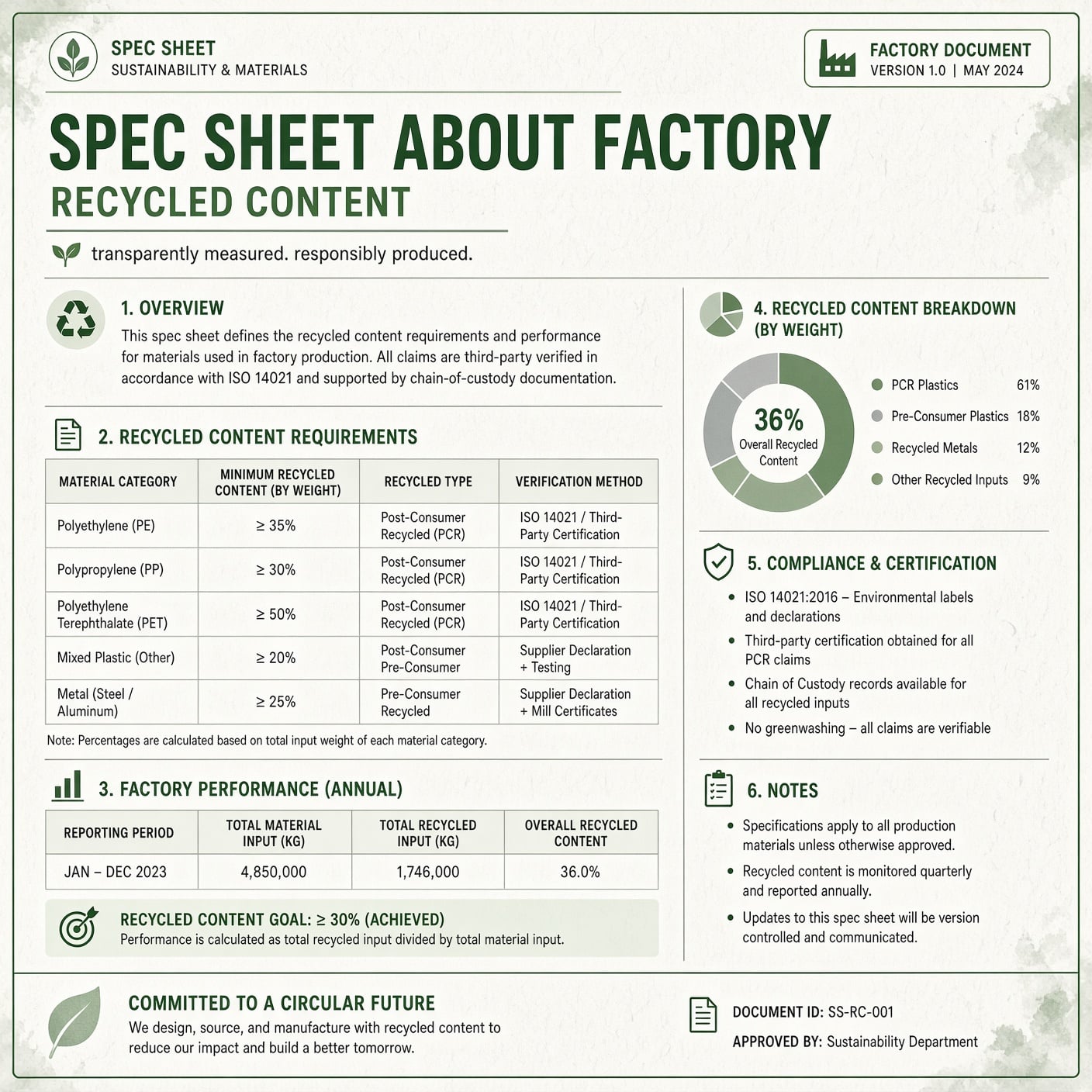
A line in the specification says the enclosure is 50 per cent recycled aluminium. It reads like a statement about where the metal came from — somebody's old laptop, melted down and pressed into yours. The standard behind that line permits a different story, in which the metal never left the factory that made it, and the claim is still correct.
The standard splits recycled in two
Environmental labelling has a governing standard, and it defines recycled content as the proportion by mass of recycled material in a product. Then it divides that material into two kinds, and the difference is the whole subject of this article.
Post-consumer material comes from products that finished their working life with a household or a business and were diverted from the waste stream. That is the meaning most people assume.
Pre-consumer material is diverted from the waste stream during manufacturing: scrap, trimmings, offcuts, by-products, overruns. Metal that was cut away from a part on the way to making it.
Both are recycled content. A claim that says only "recycled" and gives a percentage is compliant while telling you nothing about which one you have.
Why offcuts are such a large number
This matters more for machined metal than for almost anything else, because of how the parts are made. A unibody enclosure is milled out of a solid billet: the finished shell is what remains after the machine has cut away the rest. The chips and swarf removed in that process are aluminium of known, controlled alloy — the cleanest recyclable stream that exists, because it never mixed with anything.
Melting those chips back into billets is not new environmental practice. It is what every machine shop on earth has done since aluminium became cheap, for the straightforward reason that throwing away metal costs money. What changed is that the same material became eligible to be counted, and counted it was.
Our own reckoning of the scale: a manufacturer producing tens of millions of machined enclosures a year generates a stream of its own offcuts comparable in mass to the enclosures themselves. A claim of high recycled content in that setting can be satisfied without a single gram arriving from a device somebody once owned.
What one published claim actually says
Take the best-documented example in the industry. A large manufacturer states that many of its enclosures are 100 per cent recycled aluminium, and — to its credit — names the sources: its own manufacturing scrap, plus post-consumer aluminium from building and construction scrap.
Read that twice. Both named sources are legitimate recycled aluminium. Neither is a returned device. Analysts reviewing the disclosures have flagged precisely this: the public materials do not break down how much of the recycled aluminium is post-consumer material from devices taken back, versus pre-consumer industrial scrap, versus third-party secondary metal from other industries.
So "100 per cent recycled" is true, verifiable, and compatible with a device take-back programme contributing approximately none of it. The claim and the impression it creates are two different objects.
Mass balance: the accounting that lets it travel
There is a second mechanism, and it is what allows a recycled claim to be attached to a specific product at all.
Under a mass-balance chain of custody, a supplier records total recycled input and total output, and allocates the recycled share across production on paper. The physical metal in your enclosure is a mixture; the claim describes a proportion of the batch, not the atoms in the part you are holding.
The standard's 2016 revision added traceability requirements to keep this honest: a company relying on mass balance must demonstrate that the recycled material credited to its products does not exceed the volume actually received. That is a real constraint — it prevents double-counting — and it is not the constraint most readers assume. It guarantees the tonnage exists somewhere in the system. It does not guarantee it is in your device.
How much post-consumer material there is to go around
The supply side puts a ceiling on how much of any of this can be device-derived. The world generated 62 million tonnes of electronic waste in 2022, and only 22.3 per cent of that mass was documented as properly collected and recycled. Generation is rising about five times faster than documented recycling and is on track for 82 million tonnes by 2030.
For the materials that make electronics distinctive, the picture is starker: recycling meets roughly 1 per cent of demand for rare earth elements, the magnets in every speaker, motor and drive.
Our reading of those two numbers together: with roughly three-quarters of retired electronics undocumented, the pool of genuine post-consumer device material is far too small to underwrite an industry's worth of high-percentage recycled claims. Which is exactly why the claims that exist lean on construction scrap and factory offcuts — not because anyone is cheating, but because that is where recycled aluminium comes from at volume.
What the line in the specification does not tell you
- Which fraction is post-consumer. The split is the single most informative number and the one most often absent.
- Which part it describes. "50 per cent recycled aluminium" is a claim about the aluminium, not the device. If the enclosure is 300 g of a 1.4 kg laptop, the claim covers roughly a tenth of the mass.
- Whether it is physical or allocated. Mass balance is legitimate and it changes what the sentence means.
- What it displaced. Recycled aluminium takes about a twentieth of the energy of primary smelting, which is the real environmental case — and it applies equally whether the source was a skyscraper window frame or a milling machine.
The honest version of the same claim
A specification that respects the reader looks different, and examples exist. It states the percentage, the split between pre- and post-consumer, the source of the post-consumer fraction, and the part it applies to: enclosure, 100 per cent recycled aluminium, of which 20 per cent post-consumer from returned devices and 80 per cent manufacturing scrap. Everything in that sentence is checkable, and none of it stops being a genuine achievement — recycled aluminium is a real saving however it is sourced.
The standard already asks for most of this: claims must be specific, must state the percentage and the source, and must be documented well enough to survive a challenge. Vague claims without a percentage are prohibited outright. The gap is not in the rules; it is in what gets printed on the page you actually read.
Where we stand, as the shop
We do not price a product higher because its specification carries a recycled-content line, and we will not repeat a percentage in our own copy without the split behind it. When a maker gives us the breakdown, we will put it on the product page in the maker's own words. When a maker gives us a percentage and nothing else, we will say that too, in those words: percentage stated, split not disclosed.
That is not a stance — it is the only way to write the sentence without implying something we cannot verify.
The check that takes a minute
Search the product's environmental page for the words "post-consumer". If they appear with a number, you have a real disclosure and can judge it. If the page says only "recycled", the claim is compatible with material that never left the factory, and the percentage is describing a supply chain rather than a rescue.
Then find the mass of the part the claim covers. A high percentage of a small component is a smaller achievement than a modest percentage of the heaviest thing in the box — and the specification will happily quote you the first while leaving you to imagine the second.
How this was put together
Five independent sources sit under the figures above: the environmental-labelling standard's definition of recycled content by mass and its split between pre-consumer material diverted during manufacturing and post-consumer material from end users; the same standard's 2016 traceability requirements for mass-balance chain of custody, capping credited material at volume actually received, and its requirement that claims state percentage and source; a major manufacturer's published statement that its enclosures use 100 per cent recycled aluminium sourced from its own manufacturing scrap and construction scrap, together with analyst criticism that no post-consumer device breakdown is disclosed; the fourth United Nations e-waste monitor, reporting 62 million tonnes generated in 2022, 22.3 per cent documented as collected and recycled, and a trajectory to 82 million tonnes by 2030; and the finding that recycling supplies roughly 1 per cent of rare-earth demand.
The derived readings are ours: that a manufacturer machining tens of millions of unibody enclosures generates an offcut stream comparable in mass to the enclosures themselves, that a documented collection rate near a fifth cannot support industry-wide high-percentage device-derived claims, and the worked example of what a 50 per cent claim covers once the enclosure's share of total device mass is taken into account.