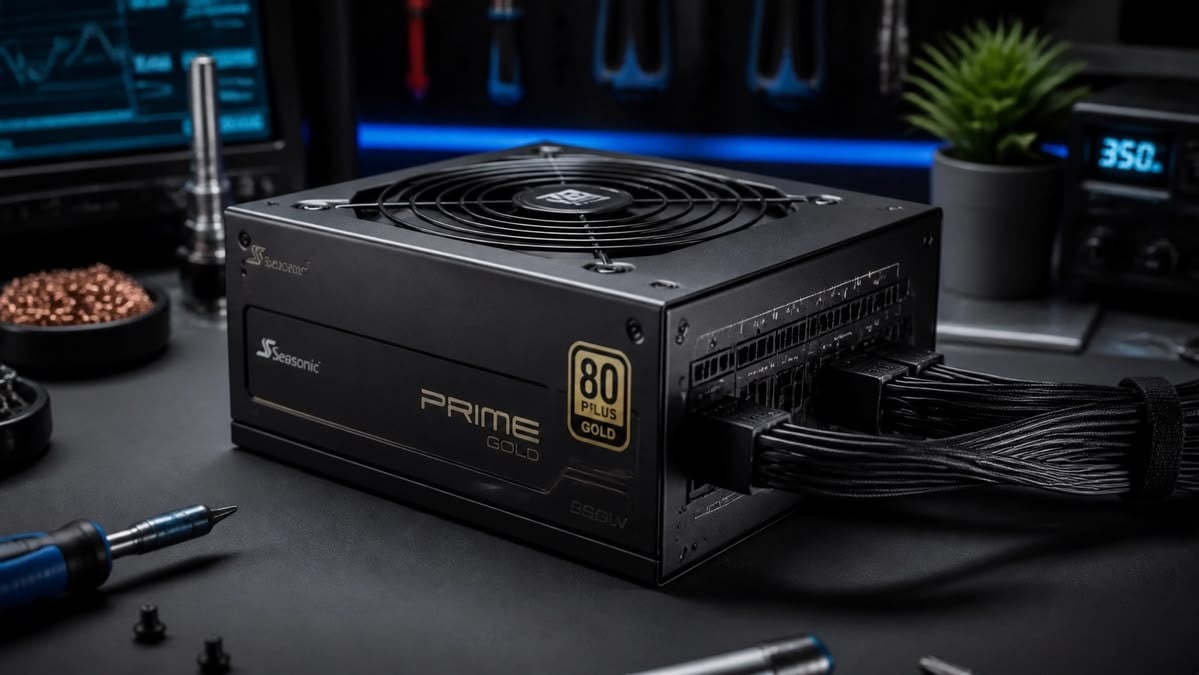
The badge on the box promises 90 per cent. The meter at the wall says the machine is drawing 96 watts while the software reports about 70 going into the components. That is 73 per cent, and the power supply is working exactly as certified.
The certification is true. It is simply a statement about three load points, and your machine spends most of its life nowhere near any of them.
What the badge actually certifies
The familiar efficiency programme tests a supply at 20 per cent, 50 per cent and 100 per cent of its rated output, and awards a tier if the unit clears a threshold at all three. The highest tier adds a fourth measurement at 10 per cent.
Three points. That is the whole test, and everything between and below them is unmeasured by the badge on the box.
Which would be a small problem if efficiency were flat. It is not.
The curve has a hump
A switching power supply has two kinds of loss. Some are roughly fixed — the controller, the standby circuitry, the magnetising current, the fan — and they are there whether the unit is delivering 50 watts or 500. Others rise with load, roughly as the square of the current, because they are resistive.
Fixed losses dominate the percentage at low output, because a constant 8 watts of overhead is a rounding error against 500 watts of output and a catastrophe against 40. Resistive losses dominate at high output. In between, the two trade off, and the efficiency curve peaks somewhere around 40 to 60 per cent of rated load before sloping down at both ends.
So the badge is measured near the top of the hump and at the two shoulders, and the region where a modern desktop actually idles — below 10 per cent — is off the left-hand end of the graph entirely.
Where your build actually sits
Work out the load factors for a real machine with a 1000 W supply:
- Idle, browsing, video — around 60 W. That is 6 per cent of rating, below the lowest point the highest tier measures and far below the lowest point most tiers measure at all.
- Gaming — around 400 W. That is 40 per cent, comfortably on the hump. This part is fine.
- Peak transient — the brief spikes a graphics card produces, which is the reason people oversize in the first place.
Now notice how the machine spends its week. The 40 per cent case happens for a few hours; the 6 per cent case happens for most of the time the machine is switched on.
The arithmetic of oversizing
Put numbers on it. Suppose the unit manages 92 per cent at its 40 per cent hump, and something like 78 per cent down at 6 per cent load — plausible for the untested region, and the sort of figure that only shows up in reviews that measure below the certification's floor.
At idle, 60 W of output at 78 per cent efficiency draws 77 W from the wall. Sixty goes into the machine and 17 W becomes heat in the supply.
Run that for eight hours a day, every day:
17 W × 8 h × 365 = 50 kWh a year.
At British domestic rates that is somewhere around £12 a year — real, but not the reason to care. The reason to care is the other end of the transaction: you paid a substantial premium for the larger unit, and at the load where the machine lives, the larger unit is the less efficient one.
The same machine on a 650 W supply idles at 9 per cent rather than 6 and games at 62 per cent rather than 40 — both closer to the hump, both cheaper to buy.
Two details that move the number more than the tier does
Your mains voltage is on your side
Efficiency at 230 volts is meaningfully higher than at 115, because half the current does the same work and resistive losses go as the square of it. Certification is performed at the input voltage of the market it is sold into, so a unit tested at 115 V and sold here will usually beat its own badge in a British socket. It is the one place in this article where the surprise is in your favour.
The badge belongs to a sample
Certification is granted on submitted units. It is not a per-unit test, and it does not describe ripple, transient response, protection behaviour or noise — the things that decide whether a supply is good as opposed to merely efficient. A unit can hold a respectable tier and have poor voltage regulation under a load step, which is precisely the condition a modern graphics card creates.
The certification that measures the whole curve
There is a second programme, less familiar on boxes, that addresses exactly this. It measures across ten load levels from 10 to 110 per cent, covers the range from about 5 per cent upwards, tests at both common mains voltages, and issues a separate rating for noise measured in an anechoic chamber.
That is a different quality of information: not three points and a tier, but the shape of the curve, including the part your machine sits in. Where a unit carries both, the second one tells you more — and where a review publishes an efficiency measurement at 5 or 10 per cent load, that single number is worth more than the badge.
Transients are the real argument for headroom
There is a legitimate reason to want margin, and it is not the one in the wattage calculators.
A modern graphics card does not draw its rated power smoothly. It produces short excursions — microseconds to milliseconds — that can reach two to three times its nominal figure as the load steps up. A supply that meets the average comfortably can still see one of those spikes as an overcurrent event and shut the machine down, which presents to the user as a random reboot under load and sends them hunting through drivers for a week.
The current generation of the desktop power standard addresses this directly: it specifies how large an excursion a compliant unit must ride out, and for how long, rather than leaving it to each manufacturer's judgement. That specification is the thing to look for. A 750 W unit built to it will handle a card that a 1000 W unit from an older generation would trip on — which is the whole argument against sizing by wattage alone.
The same standard is where the native 16-pin socket comes from, and using one is preferable to adapting a card onto older connectors for reasons that have nothing to do with efficiency.
The wasted watts become heat in your case
Efficiency is usually discussed as money, which undersells it, because the energy does not vanish — it becomes heat, in a box you are also trying to keep quiet.
Take the two operating points from earlier. At idle, 17 watts of loss is a small heater running inside the case at all times. Under a 400 W gaming load at 92 per cent, the supply is dissipating about 35 watts, which is comparable to a couple of case fans' worth of heat appearing in the bottom chamber.
Most cases now isolate the supply and draw its air from outside, which keeps that heat out of the main compartment — but it still has to be moved, and moving it is what the supply's own fan is for. Which is why a unit's efficiency and its noise are related: a less efficient unit at the same output has more heat to shift, and shifts it with the same size of fan.
That connection is why the certification programme that also measures acoustics is more useful than a tier alone. Efficiency, heat and noise are three views of the same quantity, and a badge that reports only the first is describing a third of the picture.
How to size a supply
- Work out your realistic sustained load — the card's and the processor's actual draw under a game, not the sum of every part's maximum.
- Pick the rating so that load lands at 40 to 60 per cent. That puts the hump where you live.
- Add headroom for transients, not for fantasy. A modern supply built to the current standard is specified to ride out the spikes a card produces; that is a specification to look for rather than a reason to double the wattage.
- Read a review that measured low-load efficiency and the transient response. Both are absent from the badge and both matter more than the tier.
What a tier is worth in money
Since the tiers are sold at a premium, it is worth knowing what one buys, at the load where the difference actually applies.
Take a machine drawing 400 W under load, on a supply where that is half of rating. A lower tier might manage 85 per cent there and a higher one 92. The input power is 400 ÷ 0.85 = 471 W against 400 ÷ 0.92 = 435 W — a difference of about 36 watts while gaming.
Three hours a day, every day, is a little over a thousand hours a year:
36 W × 1095 h ≈ 39 kWh, or roughly £10 a year.
Over five years, around £50. So the higher tier pays for itself if it costs less than that more — for someone gaming three hours a day. For a machine that mostly sits at idle, the sum is a fraction of it, and the argument for the premium has to be made on the build quality that usually accompanies the tier rather than on the electricity, because the electricity does not carry it.
Two things we would not buy
A 1000 W supply for a machine whose gaming load is 400 W. It costs more, it idles further down the wrong end of its own curve, and the headroom it buys is headroom the machine will never ask for. Oversizing is not free performance — it is a premium paid to operate less efficiently for most of the machine's life.
And a supply chosen on its efficiency tier alone. The tier is three measurements at loads you rarely occupy, awarded to a sample, describing none of the behaviour that separates a good unit from a mediocre one. Two units on the same tier can be very different products, and the difference is in the review rather than on the box.
How this was put together
The certification structure — the 20, 50 and 100 per cent test points, and the additional 10 per cent measurement at the top tier — is the programme's own published method. The alternative programme's coverage, ten load levels from 10 to 110 per cent, the range down to about 5 per cent, both input voltages and a separate acoustic rating, is likewise its own stated methodology. The shape of the efficiency curve and the behaviour of fixed versus resistive losses is standard switching-supply engineering, and the low-load figures come from the reviewers who measure below the certification floor rather than reporting the badge.
The derived figures are ours: the 6 per cent load factor of a 60 W idle on a 1000 W unit, the 17 watts of heat that follows at a plausible low-load efficiency, the 50 kWh and roughly £12 a year it adds up to, and the observation that moving the same machine to a 650 W unit puts both its idle and its gaming load closer to the top of the curve while costing less to buy.