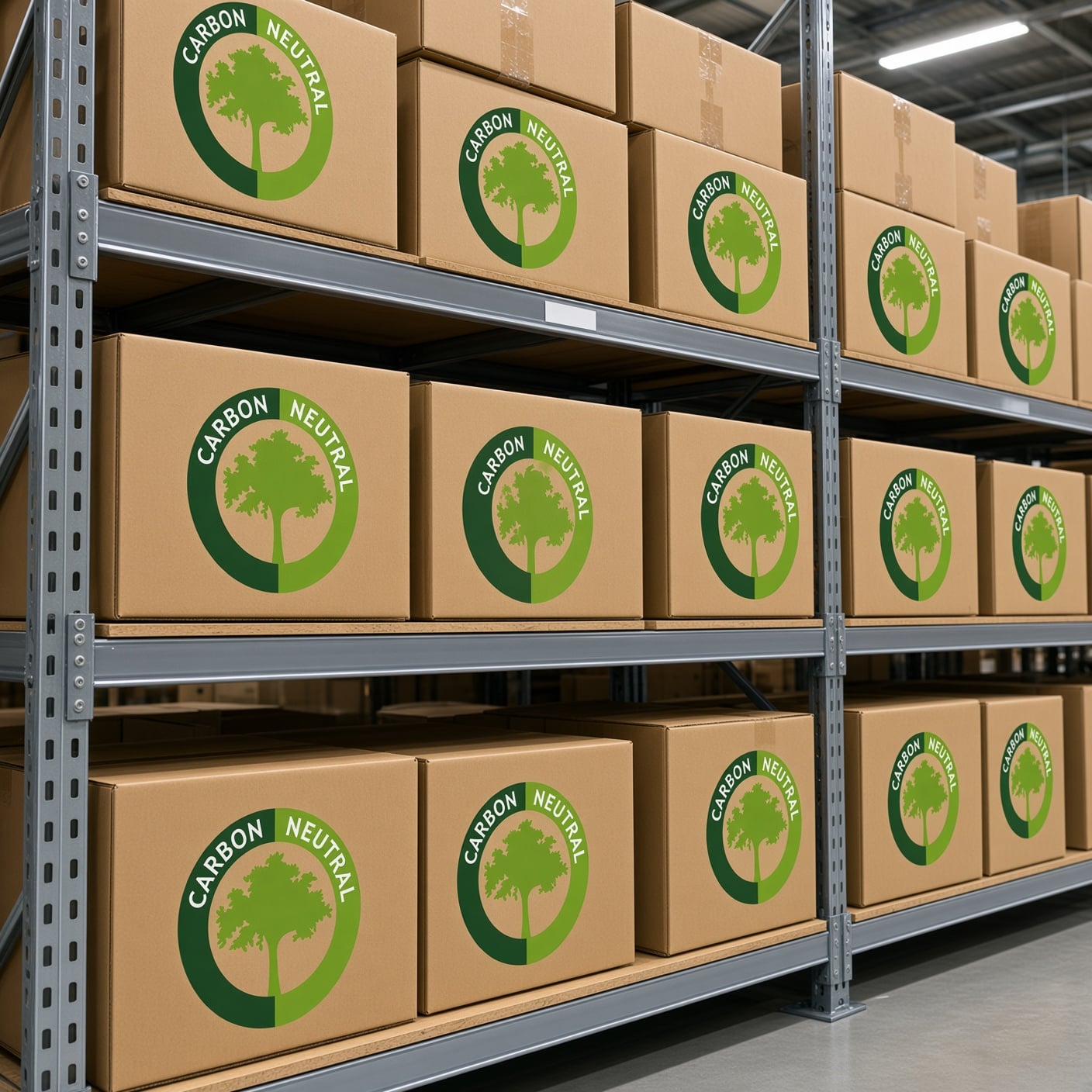
A green roundel on the carton says the product inside is carbon neutral. The product inside is the same one as last year, from the same factory, on the same ship. Nothing about the object has changed, and the claim is not a lie. It describes a transaction that happened somewhere else, in a market where a tonne of carbon dioxide costs less than the sticker announcing it.
What the word is actually claiming
Neutrality is arithmetic on two numbers: what a thing emitted, and what its maker paid somebody else to reduce or remove. There are three ways to close that gap, and they differ by a factor of a hundred in cost.
The first is to emit less — redesign, cleaner power, fewer flights of freight. The second is to buy avoidance credits, which pay a third party not to release carbon they might otherwise have released: not felling a forest, most commonly. The third is to buy removal credits, which pay somebody to take carbon dioxide out of the air and keep it out.
A badge that says carbon neutral does not distinguish between them. That is the whole story of this article, and the prices are the reason it matters.
The prices
In the voluntary market, forest-protection credits — the avoidance kind — transacted at an average near six dollars a tonne in the most recent published market data, with the broad market average sitting around four to six dollars once legacy credits are included.
Removals cost a different order of magnitude. High-integrity nature-based removals are forecast in the fifteen to thirty-five dollar range. Engineered removals — biochar, direct air capture — command one hundred and fifty to five hundred dollars and above, with direct air capture quoted from four hundred and fifty euros to over a thousand per tonne in forward offers.
Within a single project category, the highest-rated credits now sell for more than three times the price of the lowest-rated ones. Quality is priced. It is simply not priced into the badge, because the badge does not say which one was bought.
What that makes a device cost
Now put a real product footprint against a real credit price. Published product footprints for phones run from about 29 kg of carbon dioxide equivalent for the lowest-declared model to 107 kg for a large-storage flagship, with mid-range figures near 42 and 66 kg. Laptops sit between roughly 275 and 585 kg depending on the model and the report.
At six dollars a tonne, our arithmetic:
- A 66 kg phone: 0.066 tonnes × $6 — about forty cents.
- A 350 kg laptop: 0.35 tonnes × $6 — about two dollars ten.
- A whole pallet of forty phones: about sixteen dollars.
Against a phone at £999, forty cents of avoidance credit is roughly three hundredths of one per cent of the price. The printed carton, the foam insert and the plastic wrap around the pallet cost the manufacturer more than the neutrality does.
Now do it again with durable removals at two hundred dollars a tonne: the phone costs thirteen dollars to neutralise and the laptop seventy. That is a real line in a bill of materials — the kind of number a product manager argues about. The gap between forty cents and thirteen dollars is the entire difference between a badge and a commitment, and no roundel on a box tells you which side of it you are holding.
Whether the cheap tonne exists at all
The cheap end of the market has a second problem, and it is not about price. A nine-month investigation by the Guardian, Die Zeit and SourceMaterial, published in January 2023, examined rainforest credits issued by the largest certifier and concluded that more than 90 per cent of them were likely to be phantom credits representing no genuine reduction. One of the underlying analyses put the share with no climate benefit at 94 per cent, and a university study found the threat to the forests in question had been overstated by around 400 per cent on average.
The certifier disputes the finding, arguing the conclusion extrapolates from a small number of projects assessed by outside methodologies. That objection is on the record and belongs in any honest account of this. What is not in dispute is that a separate assessment of fifty widely-used projects concluded 42 of them — 84 per cent — were likely to be junk, and that the buyers named across these investigations include some of the largest consumer brands in the world.
The consequence for a shopper is narrow and useful. A product carrying a neutrality claim underwritten by cheap avoidance credits may be attached to no atmospheric change whatsoever, and there is nothing on the box that lets you tell.
The rules changed under the badge
Two things happened while these labels were multiplying.
The first is a standard. The international standard for carbon neutrality published in 2023 replaced the older British specification that many of these claims were built on, and from the start of 2025 it became the only route to a verified neutrality claim. Its central change is an order of operations: reduce first, and use offsets as a last resort rather than an accounting convenience. Claims made under the old specification did not have to demonstrate that hierarchy.
The second is a law. A European directive adopted in 2024 makes it an outright prohibited commercial practice to claim that a product has neutral, reduced or positive greenhouse-gas impact on the basis of offsetting. It is blacklisted — unlawful in all circumstances, regardless of which credit standard was used. Member states had to write it into national law by 27 March 2026, and traders must comply from 27 September 2026, including for stock already on shelves. Penalties reach 4 per cent of annual turnover.
Which means the roundel in the photograph at the top of this page has a shelf life. Anything sold to European consumers carrying an offset-based neutrality claim after that date is not merely questionable marketing; it is a prohibited practice.
The brands that dropped it first
The retreat began before the law did. One of the world's largest food companies dropped carbon-neutral pledges for its major confectionery and water brands and moved the money into reducing emissions in its own supply chain. A luxury group deleted its carbon-neutral claim from its website in May 2023. An airline abandoned offsetting as its route to neutrality and redirected the spending into cutting fuel burn.
None of those decisions was framed as an admission that the claims were empty. All three amount to the same operational judgement: that a claim costing forty cents a unit was not worth the reputational exposure of defending it.
How to read the claim, in the seconds you have
- Look for the verb. "Reduced by 30 per cent since 2019" is a statement about the object. "Carbon neutral" is a statement about a transaction. Only the first one changed the thing you are buying.
- Look for the credit type. A maker that has bought durable removals says so, in those words, because it cost them fifty times more. Silence about type means avoidance.
- Look for the footprint number. A product with a published figure in kilograms — and a report behind it — is being measured. A product with a badge and no number is being labelled.
- Look for the order. The current standard requires reduction before offsetting. A claim that cannot show what was reduced first is describing a purchase, not a programme.
What this means at the point of buying hardware
A neutrality badge on a graphics card, a monitor or a laptop tells you nothing about which of two otherwise similar products carries less carbon. The number that would tell you is the product footprint in kilograms — and even that has to be read carefully, because two makers can arrive at wildly different figures for comparable machines by making different assumptions. That is a separate mechanism, and it is the subject of its own piece.
Our own position, since a retailer writing about this owes you one: we do not put a neutrality badge on anything we sell, and we would not accept one as a reason to stock a product. Forty cents of avoidance credit is not a property of hardware. Where we can give you a number — what a thing weighs, what it draws, how long we can get spares for it — that is a property of hardware, and those are the numbers worth arguing about.
The check that takes a minute
Find the badge on any product page, then look for the footnote it points at. Nine times in ten it leads to a page naming a project and a certifier, and no tonnage. When it does give a tonnage, multiply it by six dollars: the answer is what neutrality cost the maker for the object in your basket, and you can decide for yourself whether that number represents an effort.
If the footnote names durable removals and gives a price, you have found the rare claim that survives arithmetic. Those exist. They are also, at present, easy to count.
How this was put together
Six independent sources sit under the figures above: published voluntary-market pricing giving forest-protection credits an average near six dollars a tonne and a broad market average of four to six; forecast ranges for nature-based removals at fifteen to thirty-five dollars and engineered removals from one hundred and fifty to over five hundred, with direct air capture quoted from four hundred and fifty euros; the nine-month investigation by three newsrooms into rainforest credits, with its 90 and 94 per cent findings, the 400 per cent overstatement in the underlying university analysis, and the certifier's published rebuttal; a separate assessment finding 42 of 50 examined projects likely to be junk; the 2024 European directive blacklisting offset-based neutrality claims, with its March 2026 transposition and September 2026 compliance dates and 4 per cent turnover penalty; the 2023 international carbon-neutrality standard that replaced the older specification from January 2025 and put reduction ahead of offsetting; and published product footprints for phones and laptops.
The derived figures are ours: the forty cents and two dollars ten that neutralise a phone and a laptop at six dollars a tonne, the thirteen and seventy dollars the same devices cost at removal prices, and the three hundredths of one per cent that the cheap version represents against a flagship phone's retail price.